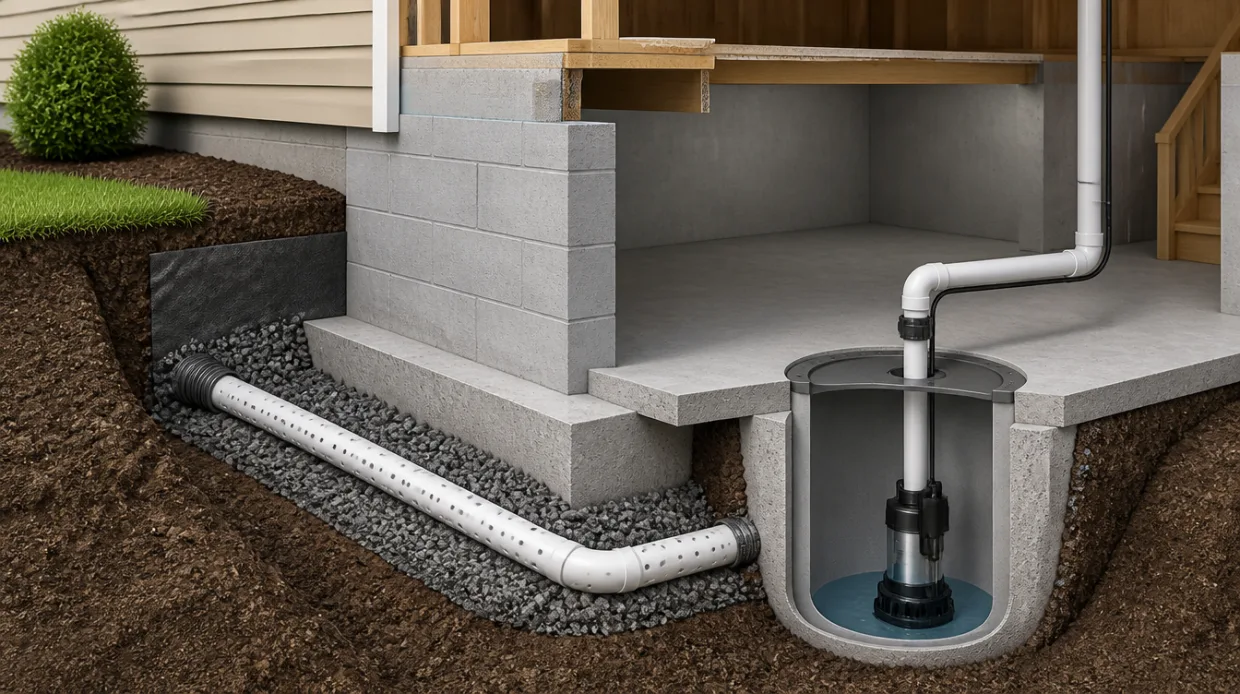
These aren't competing options. Weeping tile collects groundwater around the foundation and channels it to the sump pit, where a sump pump installation then removes it. Most complete basement waterproofing systems in Toronto use both together, and understanding how each part actually functions clears up a lot of confusion homeowners run into when researching this topic.
This confusion is understandable. Both terms get used in marketing materials and casual conversation as if they're alternative solutions to the same problem, when they're actually sequential stages of the same solution. Getting clear on what each one specifically does, and why removing either one breaks the whole system, makes it much easier to evaluate a contractor's recommendation or understand what an existing home's setup is actually doing.
What Weeping Tile Does
Weeping tile is perforated pipe installed around the foundation footing, typically surrounded by gravel, that collects groundwater before it can build pressure against the foundation wall. Rather than letting water sit against the concrete and eventually find its way through cracks or porous sections, weeping tile intercepts it early and gives it a controlled path to travel.
The gravel bed surrounding the pipe plays a role too, acting as a filter that lets water pass through into the perforations while keeping most soil and sediment out. Over decades, this filtering function can degrade as fine sediment gradually works its way in anyway, which is part of why older weeping tile systems sometimes become less effective even without any obvious external damage. The pipe typically slopes gently toward the sump pit, using gravity to move collected water there without relying on any mechanical assistance for that first stage.
What a Sump Pump Does
The sump pump's job starts where weeping tile's job ends. It removes the water weeping tile channels into the pit, discharging it safely away from the home rather than letting it accumulate. Without this step, weeping tile would just be relocating water from around the foundation into a pit with nowhere to go.
This is also where the two systems' different physical principles matter: weeping tile relies entirely on gravity and gradual gravity-driven flow, while the sump pump provides the active, mechanical force needed to actually expel water against gravity, up and out of the pit to a discharge point above or beyond the foundation level. Neither principle substitutes for the other; they're solving two genuinely different physical problems in sequence.
Why One Without the Other Is an Incomplete System
Weeping tile without a functioning sump pump just relocates water into a pit that eventually overflows once it fills, defeating the purpose of collecting it in the first place. A sump pump without weeping tile has nothing deliberately feeding it during a slow, sustained groundwater rise, it only responds to whatever water happens to seep directly into the pit incidentally, missing the water weeping tile would otherwise have intercepted around the whole foundation perimeter.
When You Might Already Have Weeping Tile
Most homes built to modern code have some form of weeping tile installed as part of original construction. Older homes, or those with unpermitted past renovation work, may have weeping tile that's damaged, clogged with sediment over the decades, or missing entirely in sections. This isn't always obvious from inside the basement, since the system is buried and generally invisible unless something has already gone wrong.
City permit records can sometimes confirm whether a documented weeping tile installation exists for a specific property, though many older Toronto homes frequently predate the kind of detailed permit records that would show this clearly and reliably today. In practice, the most reliable way to confirm actual condition, as opposed to just documented existence, is a physical inspection, sometimes including a camera run through accessible sections of the system, rather than relying on paperwork alone.
Interior vs. Exterior Weeping Tile
Weeping tile can be installed from either the interior or exterior of the foundation, and each approach comes with different trade-offs worth understanding, particularly for older homes where retrofitting is common.
Exterior Weeping Tile
Installed around the outside of the foundation footing, requiring excavation around the perimeter of the home. This is the more disruptive installation method but intercepts groundwater before it even reaches the foundation wall.
Interior Weeping Tile
Installed from inside the basement, typically along the interior perimeter of the foundation footing, without requiring exterior excavation. This is generally less disruptive and more affordable to retrofit into an existing older home, though it manages water slightly differently than an exterior system.
Neither approach is universally better, the right choice depends on the specific home's foundation access, existing landscaping, and what condition any existing system is already in. A home with mature landscaping or a finished exterior that would be costly to disturb often leans toward an interior retrofit, while a home undergoing other exterior work anyway, a driveway replacement or landscaping overhaul, might reasonably combine that project with an exterior weeping tile installation to avoid disturbing the same area twice.
Signs Your Weeping Tile Needs Attention
A handful of specific symptoms tend to point back to a weeping tile problem more often than a pump problem, even when the pump is what a homeowner notices first:
- Sump pump running excessively, more than expected given rainfall conditions, sometimes indicating the weeping tile is funneling more water than normal, or conversely, that it's clogged and forcing water to find alternate paths
- Standing water at the base of foundation walls despite a functioning pump, suggesting the weeping tile isn't collecting water effectively before it reaches the wall
- Past exterior excavation work near the foundation that may have disturbed or damaged the buried system without it being immediately obvious
How a Combined Assessment Works
BaseWorks evaluates both systems together during an assessment, since a problem attributed to one often actually traces back to the other. A sump pump that seems to be "failing" may actually be working correctly but overwhelmed by water that damaged weeping tile is funneling toward it unpredictably. Looking at the systems in isolation risks fixing the symptom, replacing the pump, while missing the underlying cause. Learning how basement waterproofing works as a complete system, rather than as separate unrelated fixes, is the foundation of getting this right, and reviewing how a sump pump system works on its own helps clarify exactly where the pump's responsibility starts and weeping tile's ends.
In practice, this often means a contractor checking pump activity logs or actual run frequency alongside a visual or camera inspection of accessible weeping tile sections, rather than treating a homeowner's service call about "the pump" as somehow isolated from the drainage system feeding it directly. A pump replaced without addressing a damaged weeping tile section frequently ends up right back at the same complaint months later, simply because the actual source of the excess water was never properly identified or addressed the first time around.
The core principle: weeping tile and a sump pump are two stages of one system, collection and removal. Neither stage compensates for a failure in the other, which is exactly why they're almost always installed and assessed together rather than as independent choices.
If You're Building or Adding On
For new construction or a significant addition, both systems are typically designed and installed together from the outset rather than as sequential retrofits. This is the ideal scenario, since the weeping tile layout and the sump pit location can be planned in coordination, rather than working around whatever existing conditions a retrofit into an older home has to accommodate. Anyone planning an addition that extends the foundation footprint should specifically confirm that weeping tile coverage extends to the new section, since a gap at the connection point between old and new foundation is a genuinely common place for this kind of system to fail years down the line, often without the failure being obvious until a specific storm exposes it directly.
Frequently Asked Questions
Yes, though it's typically less effective on its own. A sump pump without weeping tile only removes water that finds its way into the pit through incidental seepage, rather than being deliberately collected and channeled there.
Not necessarily. If existing weeping tile is functioning properly, a new or replacement sump pump can generally connect to it without requiring the weeping tile itself to be redone.
Signs of a problem include a sump pump running excessively, standing water at the base of foundation walls despite a working pump, or past exterior excavation work that may have disturbed the system. A camera inspection can confirm condition directly.
It depends on the specific home's foundation access and existing conditions. Exterior weeping tile requires excavation around the foundation, while interior systems work from inside the basement. Both approaches are used in older Toronto homes depending on the situation.