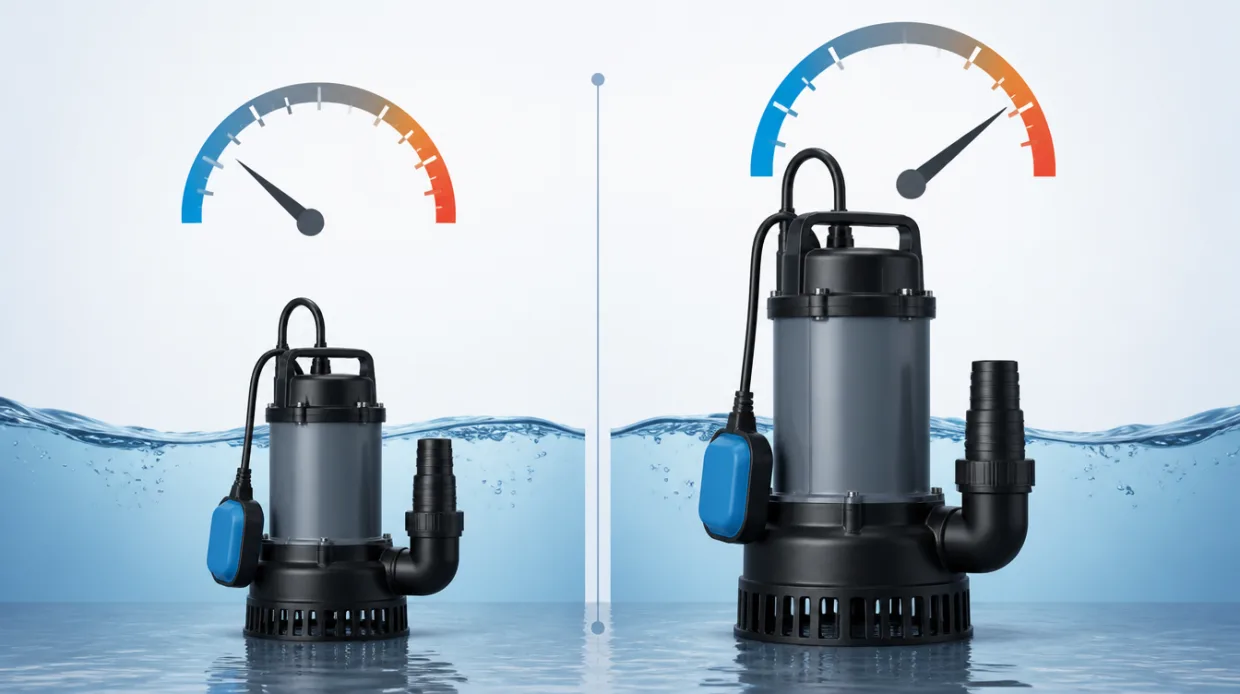
Sump pump sizing depends on the volume of groundwater a system actually needs to manage, not the square footage of the home itself. Standard Toronto conditions call for a 1/3 to 1/2 horsepower pump for a proper sump pump installation; more demanding conditions, high water tables, heavy clay soil, large catchment areas, require more.
This is a common source of confusion for homeowners comparing pumps online or shopping at a hardware store, where sizing recommendations are often generic and disconnected from the actual conditions at a specific property. A pump labeled for "average homes" tells you very little if your particular lot has a higher water table or a longer discharge run than the average the manufacturer had in mind. Getting sizing right requires understanding what actually drives the calculation, not just picking a number that sounds reasonable.
What Determines the Right Pump Size
Three specific factors determine correct sizing: pit capacity, the volume the pit itself can hold before the pump activates; incoming water volume, how much groundwater actually reaches the pit during a typical heavy event; and discharge head, the combined vertical distance and horizontal pipe length the water has to travel once pumped out. A pump that's perfectly sized for one home's discharge head might be undersized for a neighbouring home with a longer discharge run, even if the incoming water volume is identical.
Discharge head deserves a closer look since it's the least intuitive of the three factors. A pump's horsepower rating typically assumes a baseline discharge scenario, lifting water a modest vertical distance through a short pipe run. Every additional foot of vertical lift and every additional length of horizontal pipe adds resistance the pump has to work against, which effectively reduces its real-world capacity compared to the rating on the box. A pump that looks adequately sized on paper can underperform once installed with a longer or more complex discharge route than the rating assumed.
Standard Toronto Homes: 1/3 to 1/2 HP
For most detached and semi-detached homes with average catchment areas and typical groundwater conditions, a 1/3 to 1/2 horsepower submersible pump is the standard, well-tested sizing. This range comfortably handles the groundwater volume a typical Toronto lot generates during normal storm conditions, without being oversized for the actual demand.
Within this range, 1/3 HP is often sufficient for a straightforward lot with good grading and a short discharge run, while 1/2 HP provides a bit more margin for homes with a slightly larger catchment area or a marginally more demanding discharge path. Both fall within what's considered standard, and the specific choice between them usually comes down to the assessment findings rather than a dramatic difference in outcome.
When You Need 3/4 to 1 HP
Homes with a high water table, a larger catchment area, or heavy clay soil zones that retain and redirect more groundwater toward the foundation may need a 3/4 to 1 horsepower pump to keep pace with incoming water during peak events. This isn't about being cautious for its own sake, it reflects a genuinely higher water volume that a standard pump would struggle to manage during the exact storm conditions it's meant to handle.
A larger catchment area often results from a property's specific grading, roof drainage patterns, or its position relative to neighbouring lots, since surface water tends to flow toward the lowest accessible point. A home sitting at that low point in a block, even without unusual soil conditions, can end up managing meaningfully more groundwater than a similar home nearby simply due to where water naturally collects. This is exactly the kind of site-specific detail a generic sizing chart can't account for, but a physical assessment can.
What Happens If a Pump Is Undersized
An undersized pump shows its limitations exactly when it matters most. Continuous running during heavy rain, rather than normal on-and-off cycling, is the clearest early sign. Left unaddressed, this leads to premature motor failure from constant strain, and eventually pit overflow during peak groundwater events, precisely the moment the system was installed to prevent flooding in the first place.
The frustrating part of undersizing is that the pump can appear to work perfectly fine for months or years under normal conditions, giving a false sense that the sizing decision was correct. It's only during the rare, high-volume event, the exact scenario a sump pump exists to handle, that the gap between what the pump can do and what the home actually needs becomes visible. By then, the failure is happening in real time rather than during a planned inspection.
What Happens If a Pump Is Oversized
Oversizing has its own downsides. A pump that's too large for the actual incoming water volume clears the pit so quickly that it short-cycles, turning on and off far more frequently than necessary. This creates unnecessary wear on the motor and switch components over time, and the higher upfront cost of the larger unit doesn't translate into a proportional benefit if the home's actual water volume never approaches what the pump is rated for.
Short-cycling in particular shortens the practical service life of a pump, since motors and switches are generally rated for a certain number of start-stop cycles rather than pure running hours. A pump cycling on and off every few minutes during moderate rain, simply because it's oversized for the pit's actual fill rate, will wear out its mechanical components faster than one running through fewer, longer cycles matched to real demand.
How BaseWorks Determines the Right Size
Correct sizing comes from an on-site assessment of pit capacity, water volume, and discharge head, not a generic sizing chart based on square footage or a rule of thumb applied uniformly across every home. Learning how a sump pump system works as a whole helps make sense of why these specific factors matter more than home size when it comes to choosing the right pump. Our installation cost guide also covers how pump size factors into overall project pricing.
The assessment itself involves examining the existing pit if one is present, checking for any visible signs of past water volume, and discussing the home's history with the homeowner directly, past flooding, any recurring dampness, and how the specific discharge point will be routed. From there, sizing is calculated based on those actual findings rather than a chart that assumes every Toronto home behaves identically.
This same on-site approach applies whether it's a brand new installation or a replacement of an existing, potentially incorrectly sized pump. It's not unusual for an assessment to reveal that a homeowner's existing pump was undersized or oversized from the start, installed based on a generic recommendation rather than the home's actual conditions, and correcting that mismatch is often as valuable as any other part of the project.
Common Sizing Mistakes to Avoid
A few patterns come up repeatedly when reviewing existing installations that weren't properly sized from the start. One is copying a neighbour's pump choice, assuming similar homes on the same street must need the same pump, without accounting for differences in grading, catchment area, or discharge routing between the two properties. Another is choosing based purely on price rather than matching the pump's actual rated capacity to the home's water volume, which can lead to either of the undersizing or oversizing problems described above.
A third common mistake is failing to reassess sizing after a renovation that changes drainage patterns, adding a new addition, regrading the yard, or altering how surface water flows toward the foundation. A pump correctly sized for the home's original conditions may no longer match its water volume after changes like these, which is worth flagging to a contractor if you're planning renovation work that touches drainage or grading.
The core principle: correct sizing, not maximum sizing, is the goal. A pump matched to your home's actual pit capacity, water volume, and discharge head performs better and lasts longer than one chosen by guesswork in either direction.
Frequently Asked Questions
Not without a downside. An oversized pump for your actual water volume leads to short-cycling and unnecessary wear, and costs more upfront without a proportional benefit. Correct sizing, not maximum sizing, is the goal.
It's a factor, but usually a modest one compared to other cost drivers like discharge routing complexity or whether a new pit needs to be excavated. Our full cost guide breaks down the larger factors involved.
Signs include the pump running continuously during heavy rain rather than cycling on and off, the pit filling faster than the pump can clear it, or the motor sounding strained. Any of these warrant a professional assessment.
Yes. Discharge head, the combined vertical distance and pipe length water must travel, affects how much work the pump has to do beyond simply lifting water out of the pit, and factors directly into correct sizing.