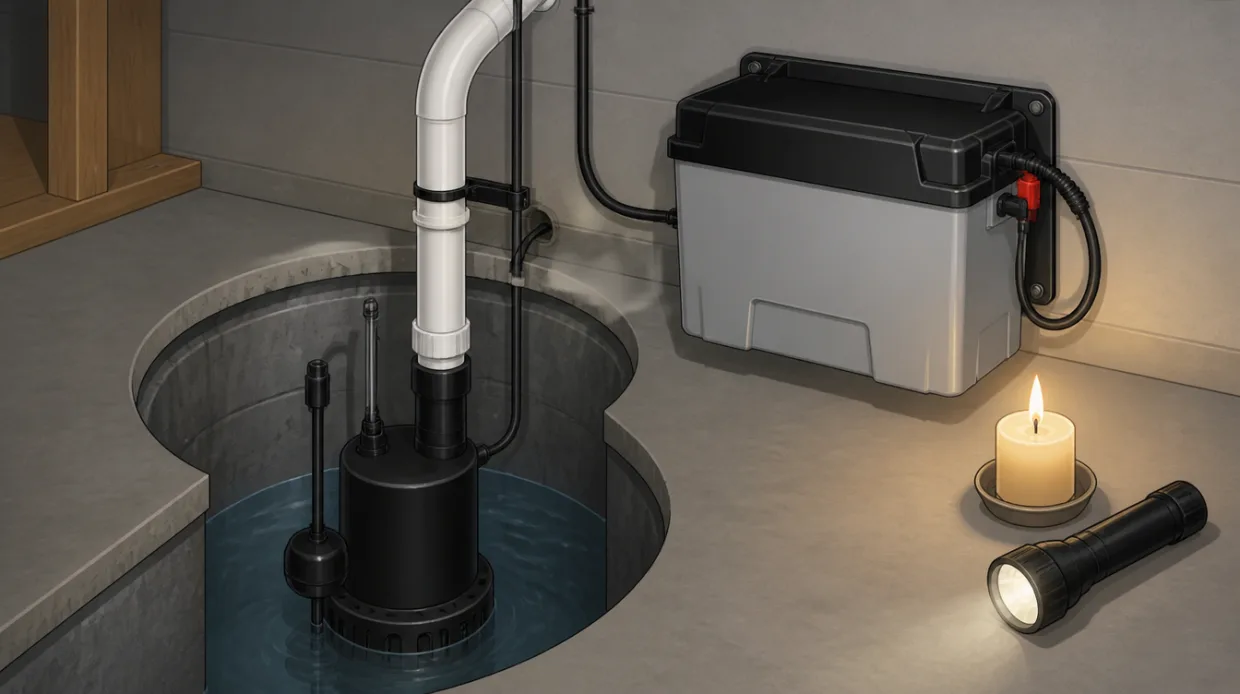
Toronto's most significant basement flooding events, summer thunderstorms and spring melt, are exactly when power outages are most likely. A battery backup activates automatically when the primary pump fails or loses power, closing the gap between a sump pump installation that works fine on a normal day and one that keeps working during the storm that actually matters.
This isn't a question we get asked in the abstract. It comes up specifically after a homeowner has either experienced a flooded basement during a storm-related outage, or heard about one happening to a neighbour, and wants to understand whether the added cost of backup power is worth it for their own home. The honest answer depends on a few specific factors covered below, but for most Toronto homes with any real storm exposure, the case for adding it is stronger than homeowners often expect going in.
How a Battery Backup Sump Pump Works
A battery backup system pairs a secondary pump with a dedicated battery unit, wired to activate automatically the moment the primary pump loses power or fails mechanically. Once triggered, it runs independently of the home's electrical supply for 8 to 12 hours on a full charge, depending on how frequently it needs to cycle. It doesn't run continuously in the background, it sits ready, and only takes over when the primary system stops working.
The battery itself is typically a sealed, maintenance-free deep-cycle unit similar in concept to what's used in other backup power applications, mounted near the pit alongside a charging circuit that keeps it topped up during normal operation. When the primary pump's power supply is interrupted, a sensor triggers the backup pump within seconds, so there's effectively no meaningful gap in protection during the switch. The system resets itself automatically once main power is restored, recharging the battery for the next time it's needed.
Why This Matters More in Toronto Than Other Climates
Storm-driven power outages and heavy groundwater loads from clay soil often coincide directly, creating exactly the failure scenario a battery backup exists to solve. A severe summer thunderstorm that knocks out power across a neighbourhood is frequently the same storm producing the groundwater surge that a sump pump needs to handle. In climates where flooding and power outages don't correlate as tightly, backup power is a nice-to-have. In Toronto, it's addressing a specific, predictable failure pattern rather than a hypothetical edge case.
Spring melt conditions add a second, equally important version of this same underlying seasonal risk. A fast thaw following a heavy winter snowpack can produce a sustained surge in groundwater over several days, sometimes coinciding with ice-related power disruptions or utility maintenance outages that have nothing to do with a single dramatic storm event. In both scenarios, summer thunderstorm and spring melt, the pattern is the same: groundwater volume and power reliability move in opposite directions at exactly the wrong time.
What It Costs to Add
Battery backup typically adds $800 to $1,500 on top of a standard installation. Our full installation cost breakdown covers how this fits into the overall project budget alongside pit and pump costs. That additional cost is generally far less than the cost of flood remediation, damaged flooring, and drywall replacement in a basement that floods because the primary pump had no power to run on.
Who Benefits Most From Battery Backup
- Finished basements, where the cost of an unmanaged flood is significantly higher than an unfinished utility space
- Homes with valuable storage in the lower level, where flood damage extends beyond structural repair to lost belongings
- Homes with a history of power outages during storms, which is one of the signs your home needs a sump pump we cover as its own risk factor
For any of these situations, the modest additional cost buys meaningful protection against the specific scenario that causes the worst basement flooding outcomes, the primary system working perfectly right up until the moment power disappears.
Battery Backup vs. Water-Powered Backup Systems
Battery Backup
Runs independently of both electricity and municipal water pressure. Requires periodic battery testing and replacement, but doesn't depend on external utility infrastructure to function.
Water-Powered Backup
Uses municipal water pressure to create suction that removes water from the pit, requiring no battery at all. It depends on water pressure remaining available during the outage, and increases water bill usage each time it activates.
Battery backup is generally the more common and more reliable choice for most Toronto homes, since it doesn't depend on municipal water pressure holding up during the same storm event that's already straining other infrastructure. Water-powered systems can make sense in specific situations, such as homes with unreliable electrical service even outside of storms, but they're a less common recommendation overall.
Cost is also a factor worth weighing between the two. Water-powered backups typically avoid the recurring battery replacement cost, but that saving is offset by increased water consumption each time the system actually activates, along with the ongoing uncertainty of depending on municipal pressure during exactly the kind of citywide storm event that can also affect water infrastructure. For most homeowners, the predictability of a battery system, known replacement schedule, known runtime, no dependency on external utilities, outweighs the modest savings a water-powered alternative might offer.
Maintenance a Backup System Still Requires
A battery backup isn't maintenance-free once installed. The battery itself typically needs replacing every 3 to 5 years, even if it's never actually been triggered during that period, since battery capacity degrades gradually over time regardless of use. Periodic testing, checking that the backup pump activates correctly when the primary is manually disconnected, confirms the system will actually work when it's needed rather than assuming it will based on installation alone.
A good general rule of thumb is to fold this testing into the same annual maintenance routine recommended for the primary pump, checking both systems together each spring before storm season ramps up. Testing the backup specifically means simulating a power loss, unplugging or disconnecting the primary pump momentarily, and confirming the backup pump engages and moves water on its own. This is a five-minute check that catches a dead or failing battery well before an actual outage would.
Some homeowners choose to set a calendar reminder for battery replacement rather than waiting for an actual failure to reveal it, since a battery that's quietly lost most of its capacity will often still power on briefly during a quick test, without actually holding enough charge to run for the full 8 to 12 hours it's rated for. A scheduled replacement every 3 to 5 years avoids this false sense of security entirely.
This is a strong recommendation, not a hard requirement. Every Toronto home benefits from a properly sized primary sump pump. Battery backup is the layer worth adding on top for homes where a power outage during a storm is a real, not hypothetical, possibility, which for most Toronto homes describes the actual conditions they've already lived through at least once.
Can You Add Battery Backup to an Existing System?
Yes, in most cases. If your home already has a properly functioning primary sump pump but no backup, adding one is generally a straightforward retrofit rather than a full reinstallation. The existing pit and discharge routing typically don't need to change, since the backup pump shares the same pit and discharge path as the primary system. The main additional work is mounting the battery unit, wiring the automatic switchover, and confirming the backup pump is correctly and properly sized for your specific home's actual water volume and pit conditions.
This makes battery backup a reasonable option to consider even for homeowners who installed a sump pump years ago without it, particularly if a storm-related power outage since then has made the gap more apparent than it was at the time of the original installation decision. An assessment can confirm exactly what a retrofit would involve for your specific setup.
Frequently Asked Questions
Typically 8 to 12 hours on a fully charged battery, depending on how frequently the pump cycles during that period. Heavier water volume during an active storm will drain the battery faster than light, intermittent activity.
No. The backup is designed to activate only when the primary pump fails or loses power, not to serve as the main system on its own. It's a secondary layer of protection, not a replacement for proper primary pump installation.
Some insurers offer premium discounts or specific sump pump failure coverage once a backup system is in place, though this varies by provider. It's worth checking directly with your insurer once installation is complete.
Typically every 3 to 5 years, even if the backup is never actually triggered during that period, since battery capacity degrades over time regardless of use.