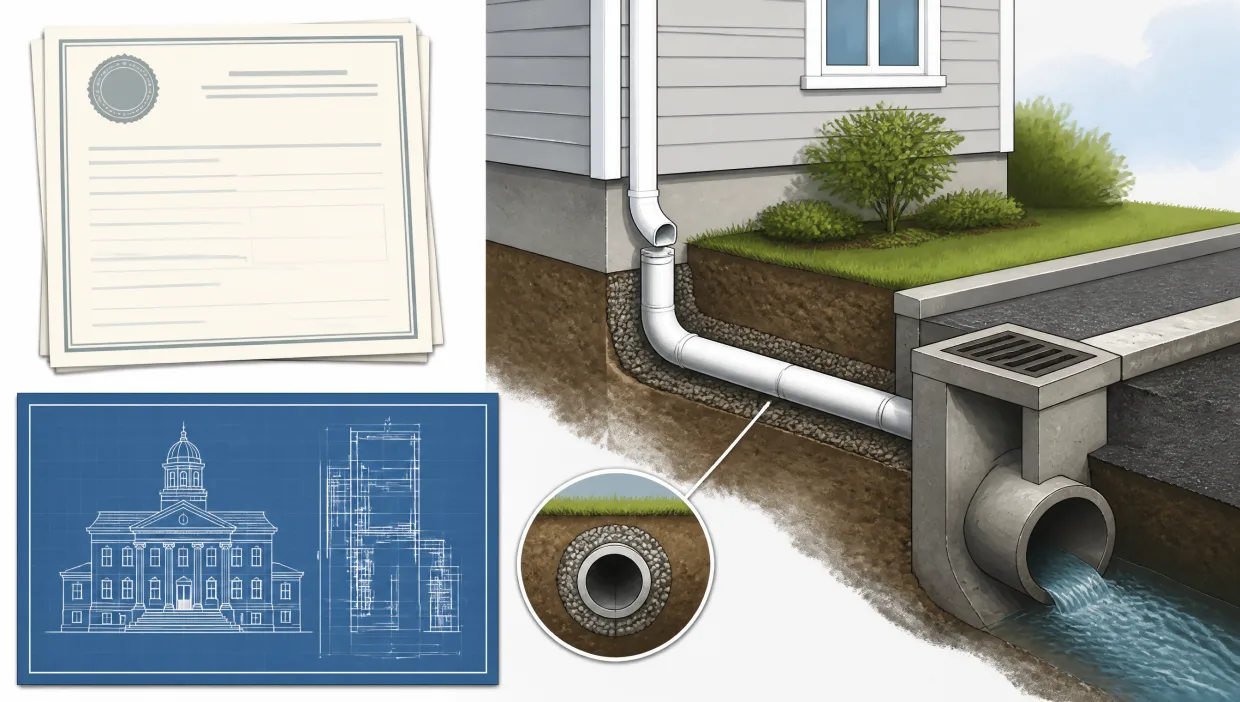
Yes, sump pump installation in Toronto connected to a sewer discharge system requires a City plumbing permit, and the discharge routing itself must comply with municipal bylaws. This guide covers both requirements plainly, what triggers the permit, where discharge is actually allowed, and what happens if either requirement gets skipped.
Permits get a bad reputation as pure red tape, but for sump pump installation specifically, the permit and inspection process exists to catch a genuinely common mistake: discharge routed somewhere it shouldn't be, either because a homeowner or unlicensed installer didn't know the rules, or because it seemed like the easiest option at the time. Understanding what's actually required upfront avoids finding out the hard way, after installation, that the system needs to be redone.
When a Plumbing Permit Is Required
Any sump pump installation connected to a sewer discharge system requires a City of Toronto plumbing permit. This applies whether it's a brand new installation or an existing system being modified in a way that changes its discharge connection. The permit process exists to confirm that the installation meets Ontario plumbing code requirements and that the discharge routing itself complies with municipal bylaws before the work is considered complete.
The trigger isn't the pump itself, it's the discharge connection. A pump discharging entirely to grade on private property, with no connection to any municipal sewer system, may fall outside the permit requirement in some cases, though confirming this with the City directly, or having a licensed contractor confirm it on your behalf, is always the safer approach than assuming. Most residential installations in Toronto do involve some form of sewer connection given lot sizes and drainage patterns, which is why the permit requirement applies to the large majority of projects.
Where Your Sump Pump Is Allowed to Discharge
Discharge routing is governed specifically by City of Toronto bylaws, and the rules are stricter than many homeowners assume. Acceptable discharge locations are:
- The storm sewer, where a connection exists and is properly permitted
- A dry well, an underground structure designed to absorb discharged water into the surrounding soil
- To grade, at least 3 meters from the foundation and directed away from the property
What's never acceptable is discharge into the sanitary sewer system. This distinction matters because the sanitary system is designed for wastewater volume, not the sudden, high-volume groundwater discharge a sump pump produces during a storm.
Each of the three acceptable options has trade-offs worth understanding. A storm sewer connection is often the most straightforward when one is available nearby, but not every property has direct, accessible access to one. A dry well is a practical alternative for properties without that access, effectively creating a controlled absorption point that lets the discharged water percolate back into the ground gradually rather than pooling on the surface. Discharge to grade is the simplest in terms of construction, requiring no underground structure, but it depends heavily on proper distance and direction, since discharging toward the house, a neighbour's property, or a low point that just redirects the water back toward the foundation defeats the entire purpose.
Which option makes sense for a specific property depends on lot grading, existing municipal infrastructure nearby, and the volume of water the system is expected to move. This is exactly the kind of decision that benefits from an on-site assessment rather than a generic answer, since the right choice for one Toronto home isn't necessarily right for the one next door.
Why Discharge Rules Exist
These rules aren't arbitrary bureaucracy. Sanitary sewers are sized for a predictable wastewater load. Adding sump pump discharge into that system during a major storm, when many homes across a neighbourhood might be pumping simultaneously, can overload sanitary infrastructure and increase the risk of sewage backing up into basements across the area, not just the one where the pump is discharging improperly. Storm sewers and dry wells are specifically designed to handle this kind of variable, weather-driven volume instead.
What Happens If You Install Without a Permit
Installing without the required permit, or discharging into a non-compliant location, carries real consequences. The City can issue fines and require forced correction of the installation, which is more disruptive and costly than doing it correctly the first time, since it means opening up completed work rather than getting it right once. Unpermitted work can also complicate a future home sale, since buyers, their lawyers, and their own inspectors increasingly ask for permit documentation on plumbing and structural work. And if improper discharge causes an issue on a neighbouring property, whether flooding, erosion, or sewage backup, the liability exposure extends well beyond a simple fine.
There's also a less obvious cost to skipping the permit: no independent verification that the work was actually done correctly. A permit and its associated inspection are effectively free quality control, a second set of eyes confirming the installation matches code before you're relying on it during an actual storm. Skipping that step means the first real test of the system is also the first time anyone finds out whether it was installed properly.
What BaseWorks Handles for You
The plumbing permit is pulled as part of the project, not left as a separate task for the homeowner to sort out. Discharge routing is determined and confirmed compliant at the assessment stage, before any installation work begins, so there's no risk of building something that later fails inspection or needs to be redone. This is reflected directly in our sump pump installation cost guide, where permit handling is included as a standard part of the quoted scope rather than an add-on surprise.
Inspection Requirements
Once the installation is complete, a City plumbing inspector confirms the work matches the approved permit application, correct discharge routing, proper connections, and code-compliant installation overall. This inspection is what actually closes the permit. Passing it is the final confirmation that the system was installed correctly, not just that a permit was filed. Keeping this documentation on file alongside your sump pump system paperwork gives you a complete record if it's ever needed for insurance purposes or a future sale.
Scheduling the inspection is typically coordinated by the contractor as part of the overall project timeline, rather than something the homeowner needs to arrange separately. A failed inspection isn't the end of the process, it simply identifies what needs correcting before the permit can close, which is far preferable to discovering the same issue on your own during an actual storm, when correcting it is no longer a simple scheduling matter.
The Real Risk of DIY Installation Without a Permit
It's worth being direct about why this specific project tempts more DIY attempts than some other plumbing work: a sump pump looks simple from the outside, a pit, a pump, a pipe. What's harder to see from the outside is exactly how much of the actual risk lives in the discharge routing and permit compliance rather than the pump itself. A DIY installer can buy a perfectly good pump, wire it correctly, and still end up with a system that violates bylaw by discharging to the wrong place, simply because that part of the process isn't obvious without knowing the specific rules.
This is different from, say, a purely cosmetic DIY project where a mistake mostly just looks a little rough around the edges. A non-compliant discharge routing carries the specific legal, financial, and neighbour-relations risk described above, none of which becomes visible until either an inspection catches it or an actual storm exposes the underlying problem directly.
The core principle: the permit isn't paperwork for its own sake. It's the mechanism that confirms your discharge routing won't cause a problem for you, your neighbours, or the municipal sewer system during exactly the kind of storm event the sump pump was installed to handle.
Frequently Asked Questions
No. Discharging into the sanitary sewer system is never an acceptable option under City of Toronto bylaws, regardless of whether a storm sewer connection is nearby. Acceptable alternatives include a dry well or discharge to grade at least 3 meters from the foundation.
It depends on whether the discharge connection itself is changing. A straightforward pump swap using the existing discharge line generally doesn't trigger a new permit, but any change to the discharge routing does.
Timelines vary depending on City processing volume and the complexity of the specific application, but straightforward plumbing permits for a standard installation are generally processed faster than larger structural permits.
Ultimately the homeowner bears responsibility for the property, though a licensed contractor who installed the system improperly may share liability depending on the specific circumstances. This is exactly why working with a contractor who pulls proper permits matters.