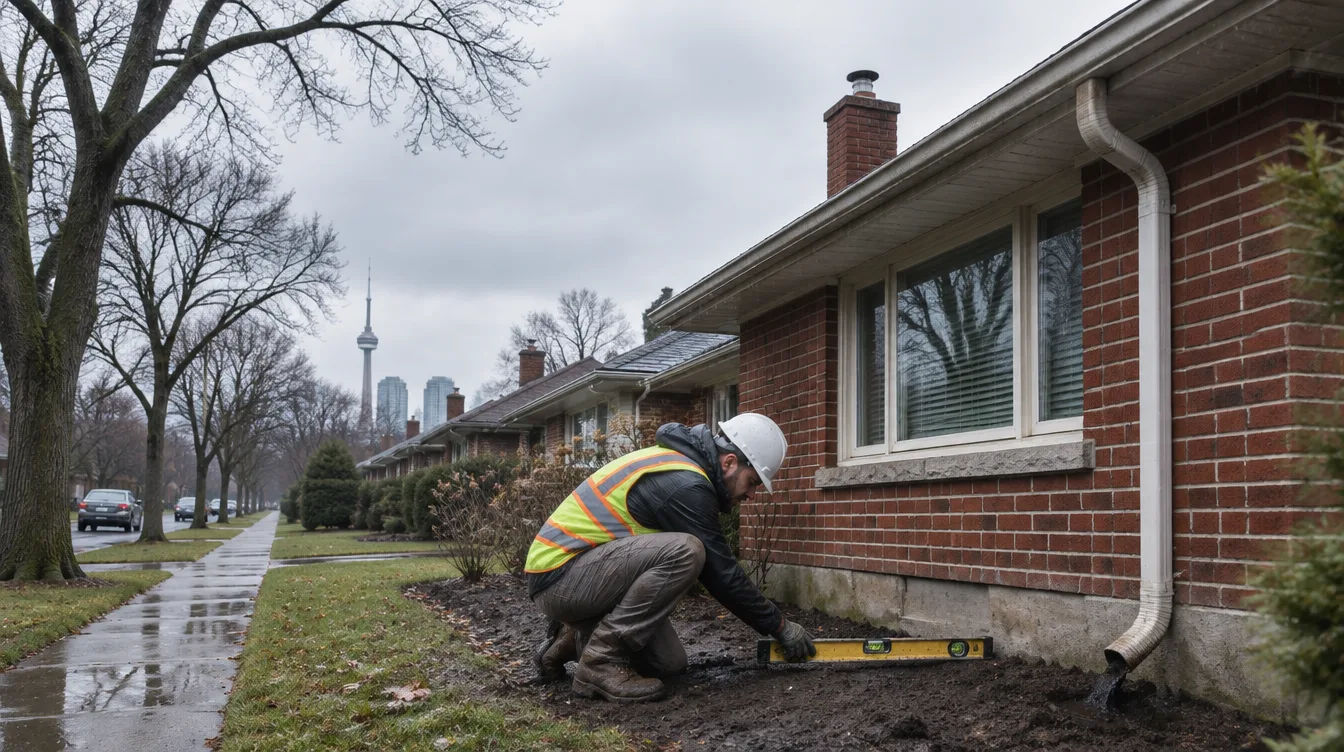
Basement waterproofing in Etobicoke and North York is shaped by the same few forces: heavy soil that holds water against the wall, creeks and ravines that move groundwater through the area, and a large stock of post-war homes whose drainage is now decades old. If you own a house in either part of Toronto, those local conditions matter more than the brand of membrane or pump a contractor happens to favour.
This guide covers what is genuinely different about Etobicoke and North York, where the two areas overlap, and what to check on your own property before you compare quotes. It is written to be careful rather than dramatic. Soil, grade and water vary from one lot to the next, even on the same street, so treat everything below as a way to ask better questions, not a diagnosis of your house. For the full range of options, see our overview of basement waterproofing in Toronto.
Short version: in both Etobicoke and North York, most basement water problems come from three things. First, clay-heavy or mixed soil that drains slowly and presses water against the foundation. Second, grading, downspouts and window wells that send surface water toward the house. Third, aging weeping tile and sump systems that no longer carry water away. Properties near the Humber, Mimico Creek, Etobicoke Creek, the Don River branches or Black Creek may also face higher groundwater and conservation authority rules. A site visit is the only way to know which of these applies to your home.
Two Areas, Many of the Same Problems
Etobicoke and North York sit at opposite ends of the city, but a homeowner in Mimico and a homeowner in Willowdale often describe nearly the same thing: a damp corner after spring melt, a musty smell in a finished basement, efflorescence on a block wall, or a sump pit that runs more often than it used to. That is partly because both areas contain a lot of housing built in the decades after the Second World War, including bungalows, split-levels and two-storey homes on lots that were graded for the drainage standards of the time.
It is also because both areas are part of the same broader landscape. Much of Toronto sits on glacial deposits, and clay, silt and till are common across the city. We cover how that behaves in detail in our guide to waterproofing in Toronto clay soil, so this article focuses on what is specific to the west end and the north end rather than repeating it.
One caution before going further. Neighbourhood-level statements about soil are generalizations. A lot beside a ravine can have very different ground from a lot two streets inland, and an infill house next to a 1950s bungalow may have been built on backfilled soil that behaves differently again. Any claim about your specific property should come from a site assessment, ideally with a geotechnical opinion if the situation is complicated.
Soil: Why Slow-Draining Ground Matters Against a Foundation
Clay and clay-rich till do not let water pass quickly. When rain or snowmelt soaks the ground beside a foundation, a slow-draining soil can stay saturated for days or weeks, which means the wall sits in wet ground for much longer than it would in sand or gravel. That sustained moisture, and the pressure that comes with it, is what pushes water through cold joints, cracks, tie holes and the joint where the wall meets the floor.
Soil also swells and shrinks. Clay-rich ground tends to expand when wet and contract in dry spells, and it can also move with frost. Over many years that movement can open small cracks in a wall, shift a downspout extension, or pull the grade back toward the house. None of that is unique to Etobicoke or North York, but both areas have plenty of properties where it is relevant.
Some lots in both areas include sandier or siltier pockets, particularly closer to valleys and former stream channels. Those soils drain faster, which can help, but they can also carry groundwater quickly toward a low point, such as a basement floor slab. The practical point is that two houses with the same symptoms can have different causes, which is why we do not recommend a fixed fix before an assessment.
Etobicoke: Creeks, the Humber and the Lake
Etobicoke sits between the Humber River and Etobicoke Creek, with Mimico Creek running through the middle and Lake Ontario along the south edge. Our guide to basement underpinning in Etobicoke describes that geography from a structural point of view. For waterproofing, three things are worth knowing.
Proximity to a watercourse. Homes near a creek or river valley can see higher soil moisture and, in some cases, a groundwater level that rises in wet seasons. That does not mean every home near a creek leaks, but it does mean the drainage around the foundation has less margin for error. Weeping tile that is partly silted up may cope in a dry year and fail in a wet one.
Lakeshore conditions. Near the lake, lot elevations are often low and groundwater can sit closer to the surface. Basements in these areas may be more sensitive to high water table conditions, and a sump system can run often during wet periods. A battery backup becomes much more worthwhile in that situation, since a power outage during a storm is exactly when water pressure is highest.
Housing mix. Etobicoke includes older lakeside neighbourhoods, post-war family streets and newer infill and rebuilt homes. Older foundations may be concrete block or poured concrete of varying quality, and each responds differently to repair. Newer homes built next to older ones occasionally change drainage patterns for their neighbours, which is worth keeping in mind if water appears after a nearby build.
North York: Ravine Lots, Branches of the Don and Black Creek
North York is larger and more varied than most people assume. It contains branches of the Don River, including the West Don and East Don, ravine lots, and in the northwest, Black Creek, which flows toward the Humber. A property near any of those valleys may have a steeper lot, more variation in grade, and a closer relationship with groundwater than a property on a flat interior street.
Slope and grade. On a sloped lot, surface water arrives at the house from uphill, and the wall on the high side often takes the brunt of it. If the grade has settled or been altered by landscaping, driveways or additions, water can pool against the foundation instead of running away. Fixing the grade and downspout discharge is often the cheapest improvement available, and it should always be checked before any excavation is proposed.
Walkouts and window wells. Houses built into a slope often have walkout basements or deep window wells. Window wells without working drainage fill with rain and snowmelt, and the water finds its way through the window frame or the wall below it. This is a common and often overlooked source of leaks in homes on ravine-edge and sloped lots.
Older planned neighbourhoods. North York includes areas laid out in the 1950s and 1960s with consistent house types. When one house on a street has a particular drainage weakness, such as a failing footing drain, neighbours with the same age and construction may share it. That is not a guarantee, but it is a useful reason to ask what has been done on nearby properties.
Older Homes: Footing Drains, Walls and Window Wells
Whatever the neighbourhood, the age of the house often explains more than the address. Many post-war homes in both areas were built with a perimeter footing drain, often called weeping tile, that was sized and installed to the standards of its day. After fifty years or more, some of that drainage is partly blocked with silt, crushed, or disconnected from where it was meant to discharge.
Wall construction matters as well. Poured concrete walls leak mostly at cracks and joints. Concrete block walls can allow water to move through the face of the block and up the cores. Parging and old coatings may have deteriorated. Each condition calls for a different response, and our guide to interior versus exterior waterproofing explains how the choice of method follows from what the wall and drainage are actually doing.
The water often is not coming from where you see it. A damp patch at a floor-wall joint may be hydrostatic pressure from the footing, a leaking window well, or surface water traveling along the wall. That is why a careful contractor looks outside the house as well as inside it.
Local Conditions at a Glance
| Local condition | What it can look like | What we check |
|---|---|---|
| Slow-draining clay or till | Damp after long wet spells, seepage at floor-wall joint | Weeping tile condition, wall cracks, soil at excavation points |
| Creek or valley proximity | Seasonal water rise, sump running often in spring | Sump capacity, discharge path, backup power |
| Lakeshore or low lot | Higher water table, water at the slab edge | Floor drainage, pump sizing, battery backup |
| Sloped or ravine lot | Leaks on the uphill wall, wet window wells | Grade, downspouts, window well drains, walkout doors |
| Aging footing drain | Recurring damp, pump cycling more than before | Camera inspection, flow test, connection to sump |
| Block or older wall | Efflorescence, damp along the face of the wall | Wall material, parging, coating and crack pattern |
No row on its own decides the fix. Most houses show a mix, such as an older drain on a gently sloped lot with a leaking window well, and the combination is what the recommendation should address.
Sump Pumps in Etobicoke and North York
Sump pump enquiries are common in both areas, and for good reason. A sump collects water from the footing drain and pumps it away from the house, which makes it the practical last line of defence when the ground around a foundation is wet. If your pit runs frequently in spring, or has never been sized for current conditions, it deserves attention before the next wet season.
A few planning points apply across both areas. Pump capacity should match how much water the system actually collects, not a default size. The discharge needs to carry water well away from the foundation and must not simply recirculate. A battery backup is worth considering anywhere power outages and storms overlap. Our sump pump installation cost guide explains what goes into the price of a new system, and our comparison of sump pump versus weeping tile shows how the two work together rather than replacing each other.
A pump does not fix a wall or a drain by itself. It manages water that is already collected. If the footing drain is blocked, a new pump may help only partly, so the drain and the pump should be assessed together.
Rules and Approvals Worth Knowing
Several rules can affect waterproofing work in these areas, and it is worth checking them early rather than mid-project.
Conservation authority areas. Properties near valleys, ravines, watercourses or the shoreline may fall within an area regulated by the Toronto and Region Conservation Authority. In a regulated area, excavation, grading changes or work near the slope may need a permit or at least a conversation with the authority. Many homes in both Etobicoke and North York are near such features. You can check your address through the TRCA, and we flag it at the assessment when a property looks likely to be affected.
City of Toronto requirements. The City has rules on how downspouts and sump pumps discharge, and it has offered programs related to basement flooding protection, such as backwater valves. Rules and programs change, so confirm the current details with the City before relying on any of them. A contractor should know what applies and explain it plainly.
Building permits. Waterproofing alone does not always need a building permit, but work that touches structure, such as underpinning or lowering, does. If your project combines the two, the permit path is different. See our guide to the basement waterproofing permit process for what typically applies.
Choosing a Fix That Fits the Cause
There is no single correct answer for Etobicoke and North York. Interior systems, which collect and redirect water from inside the basement, are often practical when exterior access is limited, when the lot is tight, or when the main issue is water at the floor-wall joint. Exterior waterproofing, where the wall is excavated and sealed from outside, makes more sense when the wall itself is the problem and access allows it. Many houses benefit from fixing the grade and downspouts first, then adding drainage or a sump where the evidence supports it.
What we would caution against is a one-size-fits-all package sold before anyone has looked at the outside of the house. The right order is usually to find the source, fix the cheapest and most likely causes first, and escalate only when the evidence calls for it.
A Short Checklist to Run Before You Call
- Note where and when water appears: after rain, after snowmelt, or all year.
- Walk the outside after rain and check where downspouts discharge and whether the grade slopes toward the house.
- Look at window wells for standing water, debris or missing drains.
- Check whether your sump pit runs more often than it did a few years ago.
- Find out whether your address is near a ravine or watercourse and whether the TRCA may regulate it.
- Photograph damp areas with a date, so changes over time are visible.
How BaseWorks Approaches Etobicoke and North York Homes
We start with a free in-person assessment that looks at the outside as carefully as the inside: grade, downspouts, window wells, wall material, sump and drain condition. We explain what we find in plain terms, say what is likely and what we cannot know without opening something up, and give a written scope so you can compare it against any other quote.
If a cheaper, less invasive fix is likely to solve the problem, we say so. If the picture is more complicated, we explain why and what the sensible sequence is. To book an assessment for a home in Etobicoke or North York, call (437) 291-7723.
Frequently Asked Questions
The methods are the same, but the common causes differ a little. Etobicoke has more creek, river and lakeshore influence on groundwater, while North York has more sloped and ravine lots where grade and window wells drive many leaks. In both areas, clay-heavy soil and aging footing drains are common contributors. Your own lot matters more than the district.
Clay and clay-rich till are common across much of Toronto, including parts of both areas, but soil varies from lot to lot and some pockets are sandier or siltier. A site assessment, and a geotechnical opinion if needed, is the reliable way to know what your property sits on.
Not always. If your property is inside an area regulated by the Toronto and Region Conservation Authority, such as near a valley, ravine, watercourse or shoreline, excavation or grading changes may need a permit. You can check your address with the TRCA, and we flag likely cases at the assessment.
They do different jobs. Weeping tile collects water at the footing and a sump pump moves it away from the house. If the drain is blocked, a pump alone may only partly help, so both should be assessed together. A battery backup is worth considering where storms and power outages overlap.
Start outside. Check downspouts, grade and window wells after rain, note where and when water appears, and photograph it. Then book an assessment so the cause is identified before any major work is proposed. Often the cheapest fixes come first and the larger work is only recommended if the evidence supports it.