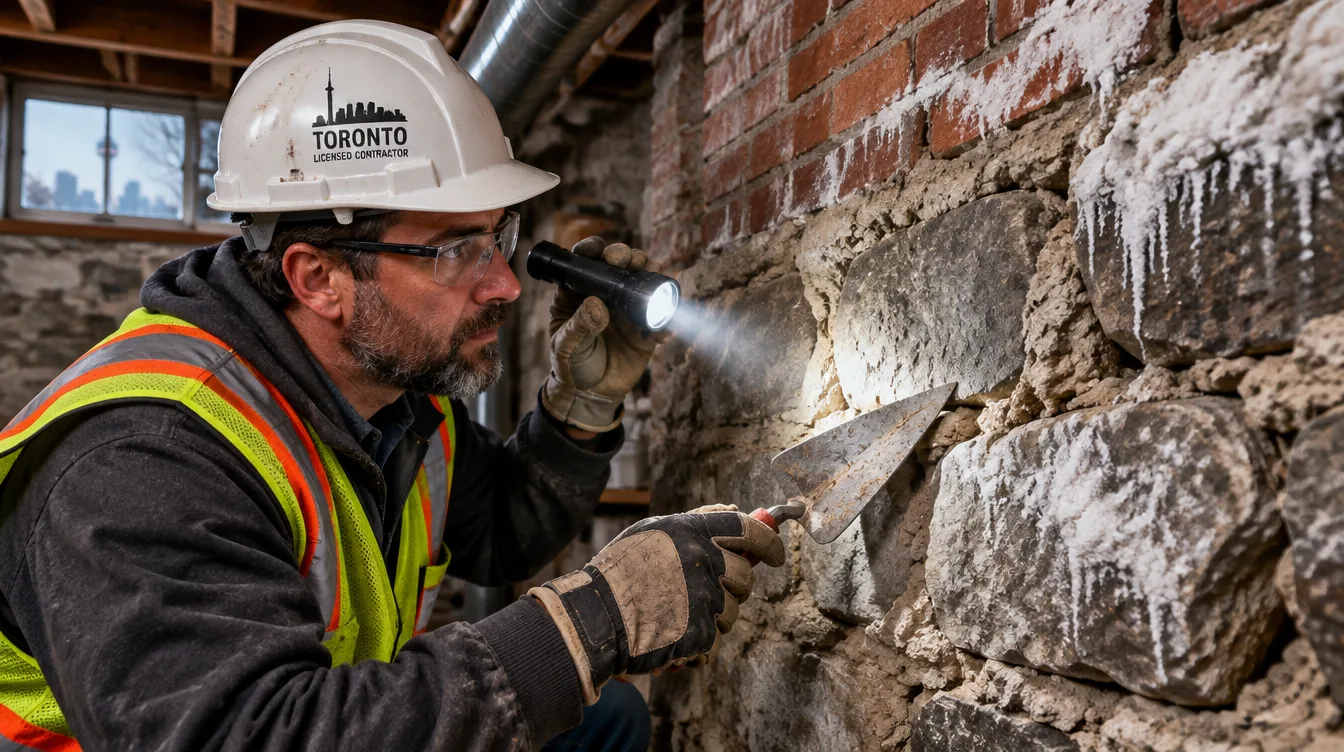
Many of Toronto's oldest houses sit on masonry foundations: rubble stone, hand-laid brick or early concrete block that has carried the building for a century or more. When those walls start to crack, shed mortar, bow or leak, owners search for brick foundation repair, masonry foundation repair or simply home foundation repair, and they quickly find that the right fix depends on what the wall is made of and why it is moving. For the full range of options, see our overview of foundation repair in Toronto.
This guide covers the older foundation types you are likely to find in Toronto, the warning signs that matter, how repointing and parging work, when a wall needs bracing or rebuilding, and when the honest answer is underpinning. It is written to help you ask better questions of any contractor. Every wall is different, so treat it as a framework, not a diagnosis of your house.
Short version: most brick and stone foundations in older Toronto homes can be repaired without replacing them. Loose or missing mortar is usually fixed by repointing with a mortar that suits the old masonry. Surface crumbling is often handled with parging. Walls that bow, lean or show horizontal and stair-step cracks need an engineer's assessment, because they point to pressure or movement rather than simple wear. Underpinning is the right answer only when the footing itself is too shallow, too weak or settling. An in-person assessment is the only way to tell which situation you are in.
Why Older Toronto Homes Have Masonry Foundations
Before poured concrete became the standard, builders in Toronto used what was available and affordable: fieldstone and rubble stone, then fired brick, then concrete block. Many houses in older parts of the city, including areas such as the Annex, Riverdale, Leslieville, Parkdale and East York, were built on one of these. They were not designed for finished basements, deep waterproofing or the loads of modern renovations, yet most have performed for generations.
That longevity is also the problem. Mortar joints soften, stone and brick faces spall, footings are shallow by today's standards, and drainage that once worked is now clogged, buried or missing. Add Toronto's freeze-thaw cycles and clay soils, and a foundation that was sound for 80 years can start to show stress. Understanding the wall is the first step toward fixing it. Our guide on when foundation cracks need underpinning explains how cracks in any foundation type are read.
Stone, Brick and Block: What Is Your Wall Made Of?
The repair depends on the material, so identify it first. A contractor should be able to tell you what the wall is made of, how it was built and what condition the mortar and footing are in before proposing any work.
| Foundation type | How it looks | Common problems | Typical repair path |
|---|---|---|---|
| Rubble or fieldstone | Irregular stones of different sizes, thick wall, often lime mortar | Washed-out mortar, loose stones, damp, shallow footing | Repointing, selective rebuilding, parging, drainage work |
| Solid brick | Regular courses, several bricks thick, often with a rough interior face | Spalling faces, open joints, efflorescence, localized settlement | Repointing, brick replacement, parging, waterproofing |
| Concrete block | Uniform hollow blocks with mortar joints | Horizontal cracks, stair-step cracks, bowing from soil pressure | Crack repair, carbon fibre or steel bracing, drainage |
| Early poured concrete | Smooth or board-marked surface, often thin or unreinforced | Cracks, honeycombing, shallow footing | Crack injection, parging, selective strengthening |
Many houses mix more than one type, for example a stone foundation with a brick addition or a block rear wall added later. Each section can fail in a different way, so a good assessment walks the whole perimeter.
Warning Signs on a Brick or Stone Foundation
Some signs are cosmetic and some point to movement. The list below separates what usually needs watching from what usually needs a professional opinion sooner.
- Sand-like debris on the floor or sill: mortar breaking down, often a sign that joints need repointing.
- Open, hollow or recessed mortar joints: water and frost can enter and cause further damage.
- Flaking or crumbling brick and stone faces: spalling from repeated freeze-thaw and moisture.
- White powder on the wall: efflorescence, which shows that water is moving through the masonry.
- Horizontal or stair-step cracks: often linked to soil pressure or settlement and worth an engineer's assessment.
- A wall that bows or leans inward: a structural concern that should not be left.
- Doors, windows or floors that have shifted: may indicate movement somewhere in the foundation.
- Water entering at the same spot after rain or thaw: a drainage or wall problem that is unlikely to fix itself.
A single hairline crack in an old wall is not an emergency. Several signs together, or any sign that is getting worse, deserve a visit. Photograph the area with a date so changes are easy to see.
Repointing: Replacing Failed Mortar the Right Way
Repointing means removing deteriorated mortar from the joints and filling them with new mortar. Done well, it restores the wall's face, keeps water out and protects the masonry. Done badly, it can speed up damage, which is why the type of mortar matters.
Older masonry, especially soft historic brick and stone laid in lime mortar, works as a system. The mortar is meant to be softer than the units, so moisture and movement are absorbed by the joints. If a hard modern cement mortar is packed into those joints, the wall can no longer breathe or flex and the faces of the brick or stone may crack and spall instead. A careful contractor tests the existing mortar and matches the new mix to the masonry rather than defaulting to the hardest product.
Repointing also needs to be done to a sensible depth, with joints cleaned of loose material and the surface prepared. It is often paired with drainage corrections outside, because moisture that keeps hitting the wall will undo new mortar again.
Parging and Surface Repairs
Parging is a thin cement-based coating applied to the face of a foundation wall. On an older basement it can even out a rough stone or brick face, cover repaired joints and give a base for waterproofing coatings or finishing. It is a surface repair, not a structural one: it will not stop a bowing wall or a settling footing, and it will not hold if water pressure keeps pushing through the masonry behind it.
Where bricks or stones have spalled or loosened, they can be replaced or reset before parging. Where water is the cause, parging alone is cosmetic until the water source is corrected, so we ask what is feeding the dampness before agreeing that a coating will last.
Bowing, Leaning and Cracked Walls
A wall that moves inward is under lateral pressure, usually from saturated clay soil, frost, poor drainage or a heavy load outside such as a driveway. Masonry is strong in compression but weak against sideways push, so these walls fail along mortar joints in horizontal or stair-step patterns.
The repair options depend on how far the wall has moved and whether it is still moving. Light movement may be stabilized with carbon fibre straps or steel bracing fixed to the wall and floor structure. More serious movement can require excavating, relieving the pressure and rebuilding or reinforcing the wall. In every case the cause has to be addressed: if the soil keeps pushing, new reinforcement is only buying time. An engineer assesses the wall, specifies the method and, where required, stamps the drawings.
When Underpinning Is Needed Instead
Repointing, parging and bracing deal with the wall. Underpinning deals with what is under it. If the footing is shallow, undersized, undermined by water or settling, repairing the wall above will not hold, because the support is the problem.
Signs that point to the footing include cracks that follow a diagonal or stepped line from a corner or opening, a section of the house that has dropped relative to the rest, and walls that keep moving after repairs. Underpinning extends the foundation deeper to sound soil, usually in short alternating sections, and is also the method used when owners want more headroom. We compare the two in basement underpinning in East York and older Toronto neighbourhoods, where shallow masonry foundations are common.
Many older homes need a mix: repointing and drainage corrections for most of the perimeter, and underpinning or strengthening for one problem section. A good plan targets each part of the wall for what it actually needs instead of recommending the largest job.
What Brick and Stone Foundation Repair Costs
Prices vary with the wall, access and how much has to be done, so a fair estimate follows an in-person assessment. The ranges below are the same ones we publish in our foundation repair guide, and they are a starting point, not a quote:
- Crack injection: $500 to $2,000 per crack
- Wall stabilization with carbon fibre straps: $3,000 to $8,000
- Partial underpinning: $8,000 to $20,000
- Full perimeter underpinning: $45,000 to $90,000
Repointing and parging costs depend on the area, the depth of the work and access, so they are priced after the wall is inspected. Be cautious of a quote that arrives without a visit, and equally cautious of one that offers no written scope. Ask what each line covers, which mortar will be used and how drainage will be handled.
What to Expect From Assessment to Completion
- Assessment. We inspect the walls inside and outside, check mortar, cracks, bowing, drainage and the floor, and measure movement where it matters.
- Engineer's input. Where there is bowing, settlement or a footing question, an engineer assesses the wall and specifies the repair.
- Written scope and price. You receive a clear scope, a fixed price and a sequence for the work.
- Permits. Surface repairs and crack injection typically do not need a permit. Underpinning, wall anchors and structural reinforcement need a City of Toronto building permit and engineer-stamped drawings.
- Work on site. Crack injection is usually done in a day and carbon fibre reinforcement in a few days. Underpinning takes several weeks of physical work after permits are issued.
- Drainage and finishing. Where moisture contributed, drainage, waterproofing and finishing are completed so the repair lasts.
A Short Checklist to Run Before You Call
- Identify what you can: stone, brick or block, and any later additions.
- Photograph cracks, crumbling mortar and damp areas with a date.
- Walk the outside after rain and check downspouts, grade and window wells.
- Note whether cracks are getting longer or wider over the seasons.
- Check whether doors, windows or floors have started to stick or slope.
- Gather any past repair records, drawings or permits for the property.
How BaseWorks Approaches Older Masonry Foundations
We start with a free in-person assessment, look at the wall and the water around it, and explain what we find in plain terms. If repointing and drainage are enough, we say so. If a section needs an engineer or underpinning, we explain why and what the sensible order of work is, with a written fixed-price scope. To book an assessment for a brick or stone foundation in Toronto, call (437) 291-7723.
Frequently Asked Questions
Usually yes. Most older masonry foundations can be repaired with repointing, parging, bracing or targeted rebuilding. Replacement or underpinning is considered when the footing is shallow, weak or settling. An in-person assessment, and an engineer's opinion where there is movement, shows which path applies to your home.
Repointing replaces failed mortar in the joints between bricks or stones. Parging is a thin cement coating applied over the wall face. Repointing repairs the joints themselves, while parging evens out and protects the surface. Neither one fixes a structural problem like a bowing wall or a settling footing.
Not always. A hairline vertical crack in an old wall is often minor and can be monitored. Horizontal cracks, stair-step cracks, cracks that keep widening and walls that bow inward point to pressure or movement and need an engineer's assessment.
It depends on scope. Surface repairs, repointing and crack injection typically do not need a permit. Underpinning, wall anchors and structural reinforcement need a City of Toronto building permit and engineer-stamped drawings.
Repointing and parging depend on the wall area. Crack injection is usually done in one day and carbon fibre reinforcement in about two to five days. Underpinning takes roughly four to eight weeks of physical work after permits are issued.
Often yes, but the wall and moisture need attention first. Damp, failed mortar and shallow footings should be addressed before framing and finishing, and the work usually includes drainage and waterproofing so the finished space stays dry.