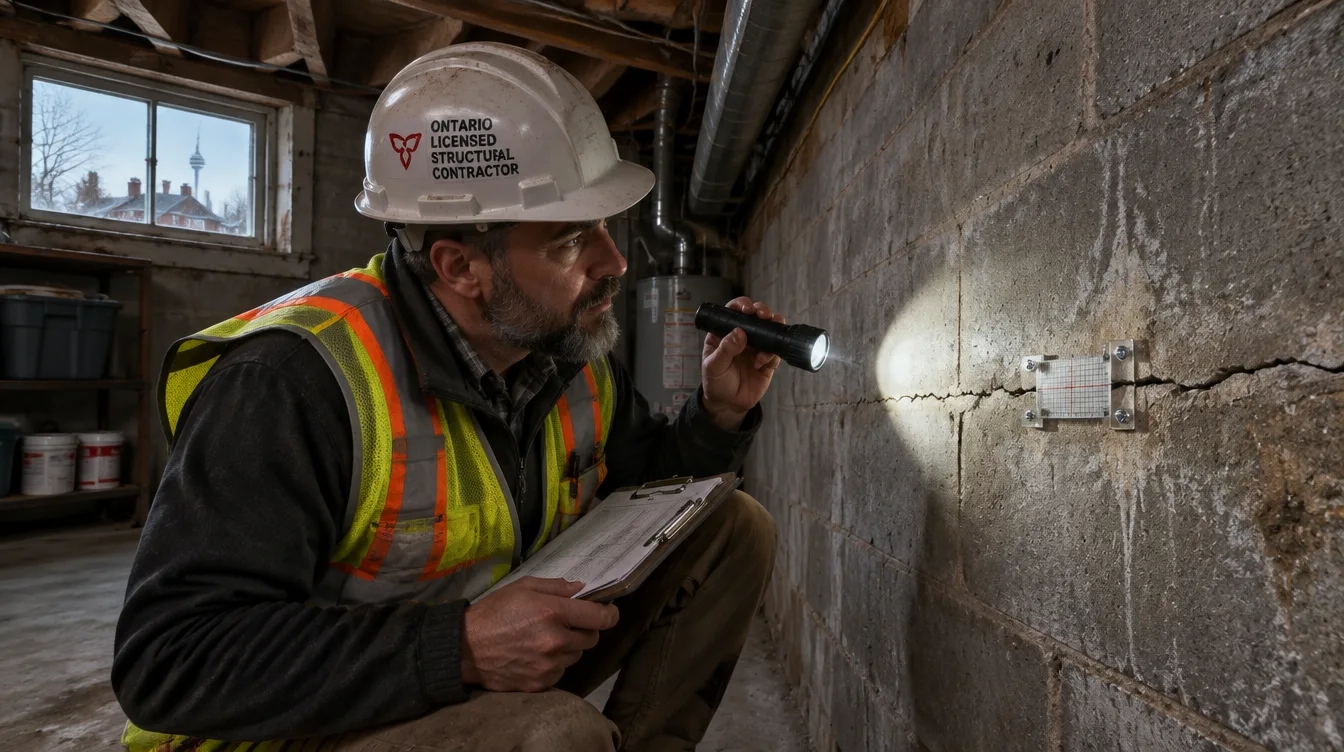
Most Toronto homeowners meet foundation repair the same way: a crack appears, a door starts to stick, or a damp patch keeps coming back in the same corner of the basement, and nobody is sure whether it matters. This guide explains what foundation repair in Toronto actually involves, the warning signs that separate a cosmetic blemish from a structural problem, the repair methods used for each, and what to expect from assessment to final inspection. If you want the full service overview first, start with our foundation repair page, then come back here for the detail.
Short version: foundation repair is a category of work, not a single procedure. A single crack injection is a $500 to $2,000 repair, wall stabilization with carbon fibre straps runs $3,000 to $8,000, partial underpinning runs $8,000 to $20,000, and full perimeter underpinning for active settlement runs $45,000 to $90,000. Every project starts with an engineer-assessed diagnosis, because the right method depends on what is moving and why.
Why Toronto Foundations Move
Toronto sits on deep deposits of glacial lakebed clay in many neighbourhoods. Clay swells when it is wet and shrinks when it dries, so the soil pressing on a foundation wall is never constant. Add the freeze-thaw cycles of a Toronto winter and a foundation is pushed and released hundreds of times over its life. Water that collects against a wall, whether from poor grading, a failed downspout or an old weeping tile line, adds hydrostatic pressure on top of that.
Age matters as well. Many homes in the older parts of the city sit on rubble stone, brick or concrete block foundations laid long before modern drainage and reinforcing standards. Mortar breaks down, joints open and walls that were never reinforced start to move inward. Newer poured concrete foundations are more resistant, but they are not immune: shrinkage cracks, cold joints and settlement under poorly compacted fill all show up in houses of every age.
None of this means a foundation is failing. Almost every house has some cracking. The skill is in telling the harmless from the structural, which is the subject of the next section.
Signs You Need Foundation Repair
Foundation problems rarely announce themselves loudly. These are the warning signs worth taking seriously, roughly in order of how urgent they tend to be.
| Sign | What it usually means | Urgency |
|---|---|---|
| Horizontal crack across a block or concrete wall | Lateral soil pressure is overcoming the wall's bending resistance | High - get it assessed promptly |
| Stair-step crack following mortar joints | Uneven settlement, one part of the foundation moving more than another | High |
| Wall that bows or leans inward | The wall has already moved and the movement will usually continue | High |
| Doors and windows that stick or gap | The structure above is reflecting movement in the foundation below | Medium to high |
| Sloping or bouncing floors | Settlement, or a failing support such as a beam or post footing | Medium to high |
| Water entering at the same spot every time | A through-crack or failed mortar joint, not just surface dampness | Medium |
| Hairline vertical crack in poured concrete | Usually shrinkage during curing, often cosmetic | Low - monitor it |
Width is a useful rule of thumb. A crack wider than about 3 mm, or one that you can see getting wider over a season, deserves an assessment. Direction matters just as much: vertical hairline cracks are common and usually benign, while horizontal and stair-step patterns point to pressure or settlement. Our guide to when foundation cracks need underpinning walks through how an engineer reads each pattern, and the checklist in seven signs your Toronto home needs basement underpinning covers the symptoms that show up inside the house rather than on the wall itself.
A simple monitoring habit helps. Mark each end of a crack with a pencil line and the date, take a photo with a tape measure beside it, and check again after a thaw and after a heavy rain. A crack that has not changed in a year is a very different problem from one that has grown.
What the Assessment Involves
Good foundation repair starts with diagnosis, not a price. Treating a symptom without finding the cause wastes money and leaves the underlying problem in place, so the first visit is about understanding what is moving and why.
- Walk-through of the interior and exterior. Cracks, wall alignment, floor levels, drainage, grading, downspouts and any signs of previous repairs are all recorded.
- Crack mapping. Each crack is measured for width, length and direction, and its location is noted against the floor plan.
- Wall and floor checks. A level and straightedge show whether a wall is bowing and how far, and whether floors above are sloping.
- Engineer involvement. Where there is evidence of movement, a structural engineer inspects the foundation and specifies the repair. Engineer-stamped drawings are required for anything structural.
- Written scope and fixed price. The result is a written proposal that says what is being done, how, and for what price.
Be cautious of anyone who quotes a foundation repair by phone or from a photo. No contractor who has not seen the foundation can tell you what it needs. BaseWorks gives a free in-person assessment and follows it with a written fixed-price proposal that includes labour, materials, permits and engineering.
Foundation Repair Methods Compared
The right method depends on the cause. These are the main options, from the smallest intervention to the largest.
| Method | Best for | Typical cost | Typical time |
|---|---|---|---|
| Crack injection | Isolated cracks in poured concrete, water entry | $500 to $2,000 per crack | Usually one day |
| Carbon fibre or steel wall reinforcement | Bowing or leaning block and brick walls | $3,000 to $8,000 | 2 to 5 days |
| Partial underpinning | Settlement localized to one or two sides | $8,000 to $20,000 | Several weeks after permits |
| Full perimeter underpinning | Active settlement affecting the whole foundation | $45,000 to $90,000 | 4 to 8 weeks of work after permits |
Crack injection
Epoxy or polyurethane is injected into an active crack in a poured concrete wall. Epoxy restores structural continuity across the crack, while polyurethane is flexible and is often chosen where the main goal is to stop water. Injection only makes sense when the cause of the crack has stopped. If the wall is still moving, the crack will simply reopen. Our foundation crack repair service covers when injection is the right call and when it is not.
Wall reinforcement
Carbon fibre straps are bonded to the inside face of a bowing block or poured wall and anchored at the top and bottom. They resist further inward movement without excavating outside. Steel anchors and wall braces do a similar job where more strength is needed. Reinforcement stabilizes a wall; it does not usually push a bowed wall back to straight, so it works best when caught early.
Underpinning
When the footing itself has settled, the fix is to extend it down to stable bearing soil. Underpinning is done in short engineered sections, one at a time, so the house is always supported. It is the heaviest intervention and the one that stops settlement permanently. It is also the same technique used to gain headroom, which is why many homeowners combine settlement repair with a lowered floor. See our basement underpinning page for how the process works.
Drainage and waterproofing correction
Many foundation problems start with water. Correcting grading, downspouts, weeping tile and sump capacity removes the load that caused the damage and protects the repair. A repair that ignores drainage may need to be repeated.
Brick, Stone and Block Foundations
Older Toronto houses often have brick, rubble stone or concrete block foundations rather than poured concrete, and these walls fail differently. Mortar deteriorates, joints open and water passes straight through. Block walls can crack in a stair-step pattern or bow inward under soil pressure because the hollow cores and mortar joints resist bending poorly.
Repair depends on what the engineer finds. Options range from repointing and parging for deteriorated masonry, to crack injection and wall reinforcement where there has been movement, to underpinning where the footing has settled. The point is that a repair chosen for a poured concrete wall may not suit a stone one, and the assessment should say so.
What Foundation Repair Costs in Toronto
Foundation repair pricing spans a wide range because the work itself spans a wide range. A single crack injection and a full perimeter underpinning are very different projects, so the question "how much does foundation repair cost" has no single answer. The ranges above come from the type of repair, and within each range the price moves with the following factors.
- Length and height of the wall being repaired or reinforced.
- Access. Narrow side yards, tight rear access and finished interiors all add labour.
- Soil and groundwater conditions found during excavation.
- Engineering and permit scope. Structural work needs stamped drawings and a City of Toronto building permit.
- Drainage work included at the same time, such as weeping tile or a sump pit.
If your repair also involves underpinning, our breakdown of basement underpinning cost in Toronto explains what drives the larger numbers. Deferring repair rarely saves money: a crack that is 2 mm today can be much wider in a few years, and early intervention is almost always less expensive than waiting.
What to Expect from Start to Finish
Most homeowners worry less about the technique than about disruption and timing. Here is how a typical project unfolds.
- Assessment and diagnosis. A free visit, followed by engineer input where movement is suspected.
- Written proposal. Scope, method, schedule and fixed price in writing.
- Permits and drawings. Crack injection and surface sealing typically do not need a permit. Underpinning, wall anchors and structural reinforcement do, along with engineer-stamped drawings. Permit review is the longest wait on larger projects.
- Preparation. Utilities are located, the work area is protected and any finished surfaces near the wall are cleared.
- The repair itself. One day for injection, a few days for reinforcement, and several weeks of physical work for underpinning.
- Inspection and close-out. City inspections where required, then a final walk-through.
Expect dust, noise and some exterior excavation on larger jobs. A good contractor protects your landscaping and interior, keeps you informed daily and does not leave the house unsupported at any point.
Choosing a Contractor and Avoiding Mistakes
Foundation work is structural, so the contractor choice matters more than the product. A short checklist helps.
- Ask who handles the engineer, the permit and the inspections, and ask for the price in writing.
- Be wary of any quote that skips an in-person assessment.
- Ask whether the repair addresses the cause or only the symptom, for example sealing a crack on a wall that is still moving.
- Confirm the contractor carries WSIB coverage and liability insurance.
- Ask how drainage will be handled, since water is behind most foundation problems.
- Keep records: photos before, during and after, plus the engineer's letter, are useful when you sell.
BaseWorks performs the full range of foundation repair in-house, from crack injection to underpinning, so one contractor owns the diagnosis and the fix.
Frequently Asked Questions
Warning signs include horizontal or stair-step cracks, cracks wider than about 3 mm, walls that bow or lean inward, doors and windows that stick, sloping floors and water entering at the same spot every time. Any single sign is worth an assessment, and several together suggest active movement.
It depends on the problem. Crack injection runs $500 to $2,000 per crack, wall stabilization with carbon fibre straps $3,000 to $8,000, partial underpinning $8,000 to $20,000 and full perimeter underpinning $45,000 to $90,000. A free assessment leads to a written fixed-price proposal.
No. Hairline vertical cracks in poured concrete are often shrinkage and can simply be monitored. Horizontal cracks, stair-step cracks and cracks that keep widening point to pressure or settlement and need an engineer's assessment.
It depends on scope. Crack injection and surface sealing typically do not need a permit. Underpinning, wall anchors and structural reinforcement need a City of Toronto building permit and engineer-stamped drawings.
Crack injection is usually done in one day and carbon fibre wall reinforcement typically takes 2 to 5 days. Underpinning takes about 4 to 8 weeks of physical work after permits are issued.
Yes. Most problems worsen over time because freeze-thaw cycles, clay soil and groundwater keep applying pressure. Early repair is almost always less expensive than deferred repair.
If you have a crack, a bowing wall or a floor that no longer feels level, call (437) 291-7723 or book a free estimate. We will look at it in person and tell you plainly what it needs, including when it does not need repair yet.