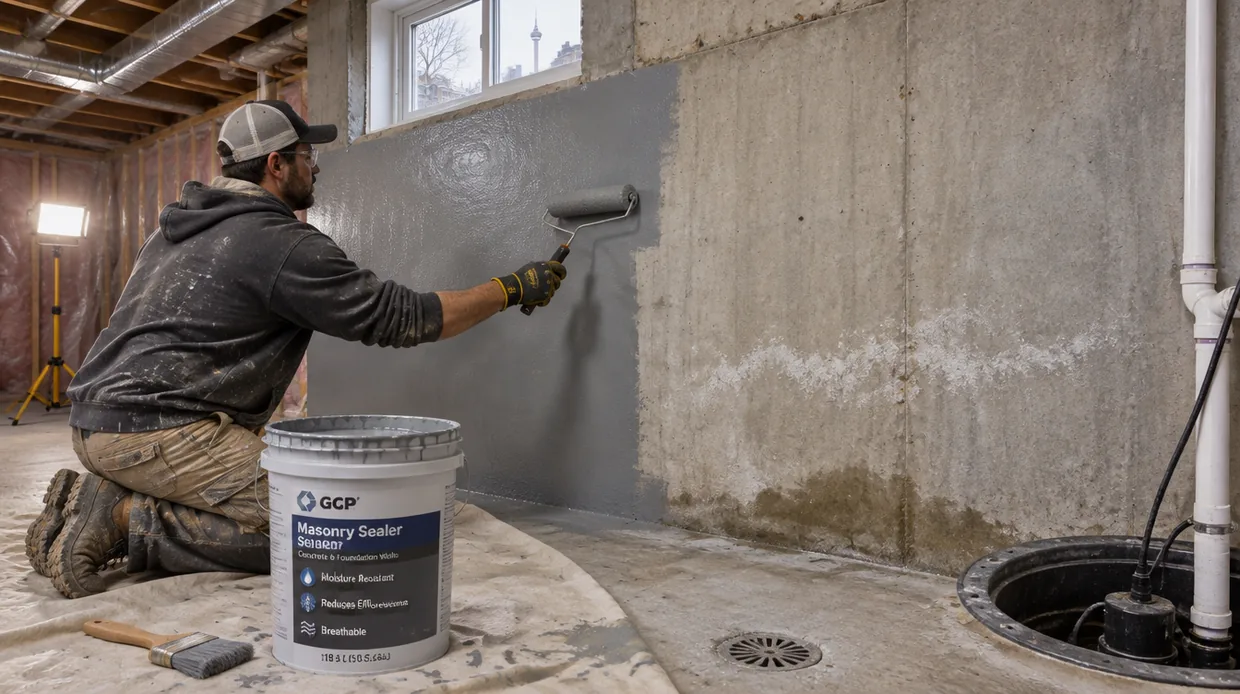
Search for help with a damp basement and you will see two words used as if they meant the same thing: sealing and waterproofing. In practice they are very different jobs. Basement sealing and waterproofing products can reduce surface moisture, slow vapour and tidy up a wall, but only waterproofing deals with the water itself. This guide explains what sealants can do, where they stop working and what a real waterproofing system does instead, so you can judge whether a coating is enough for your basement. It builds on our guide to DIY versus professional waterproofing, which covers waterproofing paint on its own, and goes further into the products, the physics and the decision.
Short version: a sealant is a surface treatment that resists dampness and vapour. Waterproofing is a drainage, barrier or repair system that stops liquid water under pressure. If water is only seeping through porous concrete, a sealant may be enough. If water follows rain or snowmelt, collects at the floor edge or comes through a crack, the source needs to be fixed and a coating will not hold.
Sealing and Waterproofing Are Two Different Jobs
Sealing means treating a surface so it absorbs less moisture. Waterproofing means controlling where liquid water goes, either by keeping it away from the foundation, collecting it and carrying it out, or blocking it at the wall. A sealant works on the surface of the material. A waterproofing system works on the water.
That difference explains most of the disappointment homeowners feel after a coating peels. The coating did what it was made to do, but the problem was pressure, not dampness. For the full definition and the main approaches, see our overview of what basement waterproofing is, and for the technical background on why Toronto clay makes this a pressure problem, read our guide to waterproofing in clay soil.
The Main Types of Sealants and Coatings
Not every product sold for basement walls is the same. They differ in how they work, and that decides where each one helps. Here are the five you will meet most often.
| Product | What it does | Where it falls short |
|---|---|---|
| Masonry waterproofing paint | Forms a thin film on the wall that cuts surface dampness and vapour | Can blister or peel when water pushes from behind; does not stop a leak |
| Penetrating silicate or siliconate sealer | Soaks into concrete and reduces how much moisture it absorbs, often used on floors and walls before finishing | Does not bridge cracks or resist pressure |
| Crystalline coating | A cementitious coating whose crystals grow into pores and fine cracks, tightening the concrete | Best on sound concrete; does not fix moving cracks, failed drainage or a wall that needs structural repair |
| Hydraulic cement | Sets quickly and can plug a small, active hole or crack | A short-term patch; water commonly finds another path |
| Crack injection (epoxy or polyurethane) | Fills and seals a through-crack in poured concrete | Seals one crack, not the water behind the whole wall |
Crystalline coatings and crack injection sit at the more capable end of the list, and they are used professionally for exactly that reason. BaseWorks describes both on its basement waterproofing page, and injection is often paired with drainage rather than used alone. The thin paints at the other end are the products that disappoint most often when they are asked to do more than they can.
Why Pressure Beats a Coating
Water pressing on a foundation is called hydrostatic pressure. Toronto's clay soil drains slowly and holds water against basement walls long after the rain stops, so that pressure builds, sometimes for days. Water takes the easiest route: a hairline crack, the joint where the wall meets the floor, a pipe penetration, or the pores of the concrete itself.
Where a coating goes matters as much as what it is made of. A membrane on the outside face of the wall is pressed against the concrete by the water, so the pressure helps hold it in place. A coating on the inside face works the other way: the water pushes from behind and tries to lift the film off the wall. That is why interior paint and sealer bubble and flake in a persistent wet spot even when they were applied carefully.
It is also why a sealed wall can look dry for a while and then fail. The water has not gone anywhere. It is waiting behind the film, or it has found another route to the floor edge. Our guide to basement waterproofing methods explains how drainage and membranes handle that pressure instead of resisting it.
When a Sealant Is a Reasonable Choice
There are honest uses for sealing, and none of them require ignoring the cause of the water. A sealant or coating makes sense in these cases:
- Damp but no moving water: a wall that feels slightly cool and damp with no trickle, drip or tide line, in a basement that otherwise stays dry.
- After the source is fixed: once drainage, grading or a membrane has solved the water problem, a breathable sealer can finish the surface and limit residual dampness.
- Before finishing: sealing a sound wall or floor is sometimes part of the preparation for framing or flooring, as long as drainage is in place first.
- Mineral deposits: white powder on the wall (efflorescence) shows moisture is moving through the concrete. A sealer can reduce it, but the cause still needs a look.
If you are planning to finish the basement, do the water work first. Our guide on whether to waterproof before finishing the basement explains the order and why it saves money.
When a Sealant Will Not Hold
A coating is the wrong tool whenever liquid water is moving or pressure is building. Watch for these signs:
- Water appears after heavy rain or spring melt, and the dampness follows the weather.
- Moisture collects along the joint where the wall meets the floor, or wells up through floor cracks.
- There is a crack with a stain, a drip or a tide line below it.
- Paint or sealer bubbles, peels or turns powdery in the same place after you redo it.
- The wall is bowed, has a stair-step crack or shows signs of movement, which is a structural question.
- The weeping tile around the foundation is old, collapsed or blocked, so there is no working drainage at the footing.
Each of those points to a source: drainage, a crack, grading or the wall itself. Fixing the source is waterproofing. Our guide to the signs you need basement waterproofing lists the warning signs in more detail.
What Real Waterproofing Does Instead
A reliable waterproofing plan works in three ways, and the right mix depends on where the water is coming from.
- Keep water away: downspouts that discharge several feet from the house, grading that slopes away from the walls, and repaired eavestroughs reduce what reaches the foundation in the first place.
- Collect and remove it: weeping tile at the footing, or an interior drainage channel paired with a sump pump, carries water away before it builds pressure on the floor and walls. See our interior waterproofing and sump pump installation pages.
- Block it at the wall: excavating and applying a membrane, drainage board and new drain on the outside face stops water before it touches the foundation. Our guide to how exterior waterproofing works walks through the steps, and the exterior waterproofing page covers the system.
Our guide to interior versus exterior waterproofing helps you pick between collecting the water and blocking it.
Comparing the Cost of Sealing and Waterproofing
Price is the main reason people reach for a coating, so the numbers are worth setting side by side. Hardware-store waterproofing paint costs roughly $50 to $150 in materials. A professional crack injection typically runs $500 to $2,000, interior drainage with a sump pump typically runs $8,000 to $20,000 for a full perimeter, and exterior waterproofing with excavation typically runs $15,000 to $40,000 depending on depth and access. These ranges are published on our basement waterproofing page, and every BaseWorks job is quoted at a fixed price.
The cheapest step is not always the cheapest outcome. A coating that fails in a wet basement costs little, but it delays the real fix while the wall, the floor finishes and any stored belongings are exposed. Where the cause is a single active crack, injection can be a proportionate repair, and our basement crack repair page explains when it makes sense. Where the cause is drainage or pressure, putting money into coatings tends to repeat the cost.
Questions to Ask Before You Agree to a Sealing-Only Quote
- What is causing the water, and how did you confirm it?
- How does this product behave when water pushes from behind the wall?
- Is anything being done about drainage, grading or the weeping tile?
- What does the warranty cover, for how long, and does it still apply if water comes back? Our guide to waterproofing warranties lists the terms to look for.
- If this does not work, what is the next step and what will it cost?
A contractor who cannot answer the first two questions is guessing. A written diagnosis, not just a product name, is a reasonable thing to expect.
Get a Diagnosis Before You Buy the Product
The most useful first step is working out where the water is coming from. BaseWorks offers a free assessment that identifies the source and recommends the lightest method that will really work, whether that is a sealer, a crack injection, drainage or an exterior system, with a written fixed-price quote. To book yours, call (437) 291-7723.
Frequently Asked Questions
No. Sealing treats the surface of the wall so it absorbs less moisture. Waterproofing controls the water itself by keeping it away, collecting it with drainage or blocking it with a membrane. A sealant can help with dampness, but it does not stop water that is pushing through under pressure.
Usually not. Paint forms a thin film on the inside face, and water pushing from behind can lift it. It can reduce surface dampness and vapour, but a leak that follows rain or snowmelt points to drainage or a crack, and that source needs to be fixed instead.
A sealer makes sense for slight dampness with no moving water, as a finishing step after drainage or a membrane has solved the cause, or as preparation before finishing a sound wall or floor. If water appears after heavy rain or along the floor joint, address the source first.
Crystalline coatings are cementitious and their crystals grow into concrete pores and fine cracks, tightening the wall. Paint forms a surface film. Crystalline products suit sound concrete but still do not replace drainage when water pressure is building, and neither fixes a moving crack or failed weeping tile.
Our published ranges are about $500 to $2,000 for crack injection, $8,000 to $20,000 for a full interior drainage system, and $15,000 to $40,000 for exterior waterproofing with excavation. Every BaseWorks project is quoted at a fixed price after a free assessment of where the water is coming from.