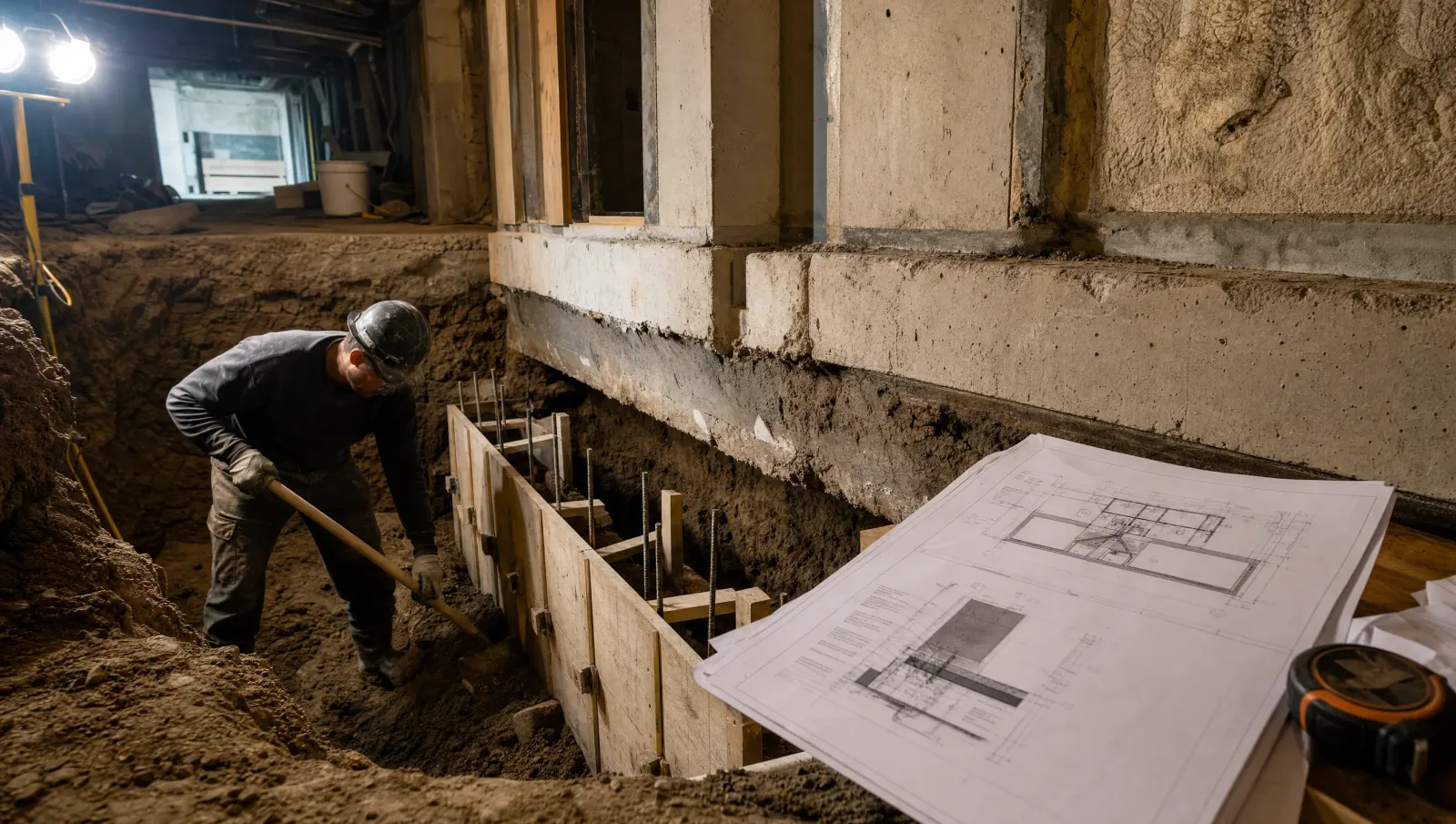
Lowering a basement is a big job, and the first question most homeowners ask is whether they can stay in the house while it happens. The honest answer is that many do, with some planning and some patience. This guide covers the day-to-day side of basement lowering: the noise, the dust, the utilities, the route the crew uses and what a normal day looks like. It does not repeat the engineering sequence, which our guide on what happens during a basement lowering covers phase by phase.
Quick Answer: Can You Stay Home During a Basement Lowering?
Quick answer: usually yes, but it is not a quiet or clean period. Expect the loudest, dustiest days at the start, a basement that is off limits, an access route through part of the house and weeks of weekday construction activity. Heat, water and power normally stay on. Whether to stay depends on your household, your work-from-home needs and how much disruption you are comfortable with.
On site, our basement underpinning page gives a typical project as 4 to 8 weeks of construction after a 4 to 8 week permit review. The permit wait happens before anyone arrives, so the part you live through is the construction window, and it is not all equally disruptive.
The Daily Rhythm: What a Normal Day Looks Like
Most days follow the same pattern. The crew arrives in the morning, sets up the work area, works through the day and cleans the access route before leaving. Once you know the pattern, it is easier to plan around.
- Morning: the crew arrives, opens the access route and starts work. Noisy tasks tend to begin once the day is under way.
- Midday: the main work happens. Material is carried out, new material is carried in and, on pour days, the concrete arrives.
- End of day: tools are put away, dust barriers are checked and the route is cleaned.
- Evenings and weekends: generally quiet. Ask your contractor to confirm the working hours in writing.
Not every phase is the same. The early excavation days are the heaviest, and later phases, such as waterproofing and the finished slab, are quieter. Our guide to the basement lowering timeline shows how the weeks fall.
Noise: What to Expect and When
The loudest period is the opening of the project, when the existing slab is broken up and soil is removed from the basement. Jackhammers, carts and compressors are loud, and the sound travels through the structure, so it is not confined to the basement. Later work is quieter, and pours are busy but less noisy than demolition.
Work is typically scheduled for weekday daytime hours, in line with City of Toronto noise bylaws. If you work from home, take calls in the room farthest from the work, or plan for the first days away from the house. Neighbours will hear it too, which is why it helps to tell them before the work starts.
- Plan quiet-dependent activities, such as exams, recordings and long calls, outside the heaviest days.
- Think about pets. Some are unsettled by vibration and noise, and may be better away from home on the loudest days.
- Ask the contractor for a rough outline of which days are the noisiest.
Dust: What the Crew Does and What You Should Expect
Breaking concrete and moving soil makes dust, and it is not realistic to promise none. What a careful crew does is limit it. Interior doorways are sealed with dust barriers, ventilation fans help manage dust and concrete fumes, and the route the material takes is protected and cleaned at the end of each day.
Even so, some fine dust still finds its way upstairs on the breaking days. Your part is simple preparation:
- Cover furniture and electronics on the main floor near the basement stairs and the access route.
- Move delicate items, framed pictures and anything breakable away from the walls above the work, since vibration travels.
- Keep the doors on the barrier closed, and ask household members to stay out of the work area.
- Change furnace filters when the crew advises, and expect more dusting than normal.
People with asthma, allergies or other breathing conditions should speak to their doctor and their contractor before the work starts, and think hard about whether to stay at home during the dustiest days.
Utilities: Heat, Water, Power and Gas
The reassuring part is that utilities are usually not interrupted. Water, power and gas typically stay on, and mechanical equipment normally stays in service. Where a basement-level connection has to move to suit the new floor, ask for any shut-off to be planned, short and announced in advance.
Some items do need attention. Our basement lowering page notes that gas, venting and water lines are extended by licensed trades when the floor goes lower, and that the engineer sizes new footings and longer posts are installed while the beam is temporarily supported. In practice, that means your furnace, water heater and laundry area need a conversation before the work, not a surprise during it.
- Ask which items in the basement will move or be protected, and when.
- Ask if any shut-off is expected, how long it will last and how much notice you will get.
- Plan laundry and storage elsewhere for the duration, since the basement will not be usable.
- Know where your main shut-offs are, and make sure the crew does too.
Access and the Route Through Your House
Soil and debris have to leave, and concrete and material have to arrive, so there is always an access route. On many Toronto houses it runs along a side yard, sometimes with a conveyor down to the basement window or a temporary opening. On others it runs through the house, which is more disruptive.
Agree the route before the work starts. Ask where soil will be loaded, where the bin or truck will sit and how the driveway and street are affected. We coordinate the placement so driveways and neighbours are blocked as little as possible, but a bin and a truck are still part of the project.
- Protect floors along any interior route with runners or boards, and ask who provides them.
- Remove items from the route so that crews are not stepping around belongings.
- Keep children and pets away from the route, the bin and the open excavation.
- Ask about parking for your own vehicles during the heaviest days.
Staying Home, Staying Away, or Something in Between
There is no right answer for every household. Our guide on how long basement underpinning takes covers the question of staying in the home, and the pattern is similar for lowering: most families stay, avoid the basement during work hours and accept the noise.
Some households make a partial plan. Staying with family for the first few noisy days, working elsewhere during the weekday, or arranging care for an infant or pet for the loudest stretch can make the project far easier to live through.
- Staying is easiest for households without infants, breathing conditions or work-from-home needs.
- A short stay elsewhere for the first week can remove the hardest part.
- Whatever you choose, tell the contractor, so the plan for the loudest days is shared.
How to Prepare Your House Before the Crew Arrives
- Empty the basement completely. Anything left will be in the way or buried in dust.
- Move delicate items away from the walls of the rooms above.
- Agree the access route and the floor protection in writing.
- Ask how the furnace, water heater and laundry will work, and plan alternatives.
- Confirm the working hours, the contact person and what happens if a problem arises.
- Photograph the basement and the rooms above before work starts, for your records.
- Tell your insurer and your neighbours that work is coming.
Talking to Your Neighbours and Your Household
Noise, trucks and bins affect the street, so a short, friendly note to the neighbours before the work starts makes the weeks easier. On semis and row houses, we contact the adjoining owner before we mobilize and record the condition of the shared wall, which is a separate conversation from the courtesy note.
Inside your own house, talk to everyone who lives there about what changes: the basement is closed, the route is off limits, the noise is real and the schedule is set by the work, not by anyone's preference.
How BaseWorks Helps
We offer a free in-person assessment, and part of it is a plain conversation about how the work would run in your house: the route, the equipment that must move, the noisiest days and the working hours. We put the scope in writing. Call (437) 291-7723 or use our contact page to arrange a visit.
This article is general information about living through a project. It is not engineering advice, and each house is different.
Frequently Asked Questions
Many families do, and it is a decision to make with your contractor before the work starts. Expect noise and dust during active phases, a basement you cannot use, and an access route through part of the house. Households with infants, breathing conditions or home offices should plan carefully, and some choose to stay elsewhere.
Usually yes. Mechanical equipment normally stays in service during the work, though it may need protection or relocation to suit the new floor level. Your contractor should identify any item that must move at the pre-construction visit, so heating and hot water are not interrupted without warning.
The loudest period is the first days, when the slab is broken out and soil is removed, with jackhammers and carts. It is a construction site, so it is loud. Work is typically scheduled for weekday daytime hours within City of Toronto noise bylaws, and your contractor can tell you the plan.
Crews seal interior doorways with dust barriers, run ventilation fans, cover the route used to carry material out and clean it at the end of each workday. Some fine dust still reaches upstairs on breaking days, so move delicate items, cover furniture and expect more cleaning than usual.
Empty the basement completely, since anything left will be in the way or covered in dust. Move fragile items away from the walls of the rooms above, agree the entry route and floor protection, and ask how the furnace, water heater and laundry will work. Then confirm the working hours in writing.