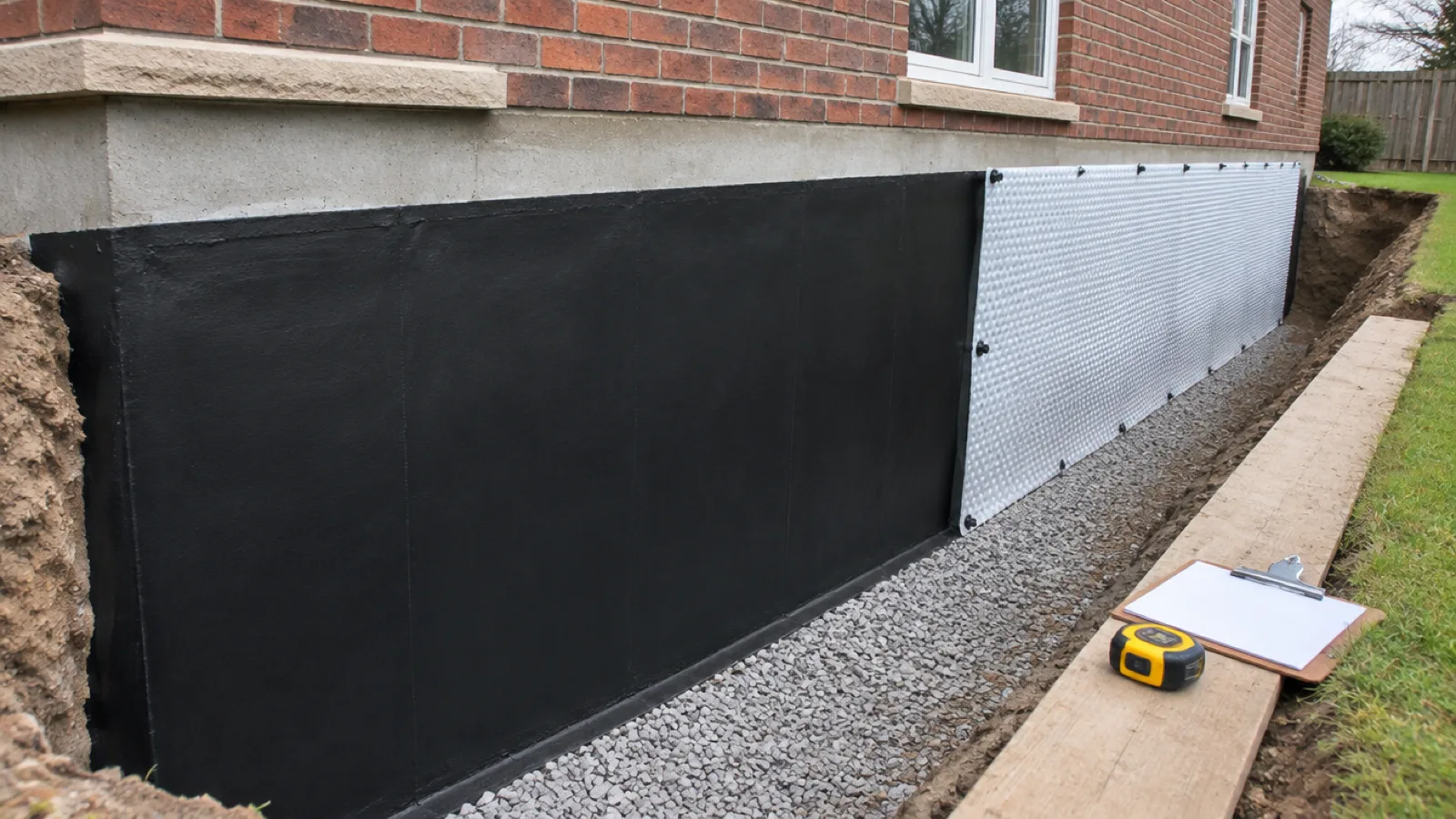
When a contractor proposes exterior basement waterproofing, one of the first choices is the membrane: the barrier applied to the outside face of the foundation wall once it has been dug out. Rubberized, sheet and bentonite membranes all appear in conversations about foundations, and the names can sound interchangeable. They are not. This guide explains what each one is, how it goes on, and which questions help you compare proposals.
Quick answer: a rubberized membrane is applied as a liquid or spray, a sheet membrane is rolled on in overlapping pieces, and a bentonite membrane relies on clay that swells with moisture. Each has general strengths and limits. Which one suits a house depends on the wall, the soil, the water table and the assessment of a qualified designer, engineer or contractor. This article is educational, and it does not name a winner.
What an Exterior Membrane Does
Below grade, soil holds moisture and groundwater can rise and fall with the seasons. A membrane is meant to sit between that wet soil and the foundation wall, so water is stopped at the outside face instead of working its way through the wall.
Exterior work means excavating along the foundation, and once the trench is backfilled nobody can look at the membrane again without digging it up. That is why the choice deserves attention.
A membrane is also only one layer. It works alongside a clean, repaired wall surface, drainage that moves water away from the footing, and careful backfill. Our guide to basement waterproofing methods compared shows how the pieces of a full system fit together.
Rubberized Membranes: Liquid or Spray Applied
A rubberized membrane is applied to the wall in liquid or spray form. It then cures into a continuous, flexible coating that follows the shape of the wall. Our own exterior waterproofing page describes a rubberized membrane system as part of an excavation project.
How it is applied. The wall is cleaned, loose material is removed and cracks and voids are repaired. The coating is then sprayed, rolled or troweled onto the wall face, working over corners and around penetrations such as pipes. The coating is allowed to cure before anything is placed against it.
General strengths. Because it goes on as a liquid, it can cover irregular surfaces, corners and the area around pipes without a lot of cutting and fitting. It forms a continuous layer without overlaps, which is why people often describe it as seamless.
General limits. Results depend heavily on wall preparation and on the person applying it, since a missed area is a gap. Curing conditions matter, and the coating needs protection while the trench is backfilled.
Sheet Membranes: Rolled and Overlapped
A sheet membrane arrives as a roll of manufactured material. Some versions stick to the wall by themselves, and others are fastened or bonded in other ways. The installer works along the wall, laying one piece after another so that each piece overlaps the one before it.
How it is applied. The wall is prepared in much the same way as for other membranes. Sheets are cut to length and pressed into place, and the overlaps and edges are sealed. Corners, transitions and pipe penetrations usually need extra detailing, because a flat sheet has to be shaped to fit them.
General strengths. Sheet material is manufactured in a controlled setting, so the material itself is consistent from one roll to the next.
General limits. A sheet system has many joints, and every overlap and edge has to be detailed properly. Ask how the seams, corners and top edge of the membrane will be finished and protected.
Bentonite Membranes: Clay That Reacts to Water
Bentonite is a type of clay that swells when it takes on water. In a bentonite membrane, the clay is carried in a panel, a sheet or a similar product and placed against the foundation. When moisture arrives, the clay swells and is intended to help seal the space against the wall.
How it is applied. The product is fixed against the wall or placed in the excavation according to the manufacturer's instructions, then covered. The way it performs relies on the clay having moisture and, in many cases, some confinement, so the installation details and the backfill matter.
General strengths. The swelling action is a different principle from a coating or a sheet, and some designers consider it where it fits the site.
General limits. Because it reacts to moisture, it needs to be kept in the conditions the manufacturer intends, and it needs to be installed carefully so it is not exposed to water too early. Ask the contractor to explain why it suits your wall.
Side by Side: A Plain-Language Comparison
| Question | Rubberized | Sheet | Bentonite |
|---|---|---|---|
| What is it? | Liquid or spray coating that cures on the wall | Rolled material laid in overlapping pieces | Clay product that swells when wet |
| How does it go on? | Sprayed, rolled or troweled onto a prepared wall | Cut, pressed or fastened, then seams are sealed | Fixed or placed against the wall, then covered |
| Where it can be useful | Irregular surfaces and detail areas | Large, flat wall areas that can be checked as installed | Sites where a swelling barrier fits the design |
| Where to be careful | Coverage, preparation, curing and protection | Seams, corners and edges | Moisture exposure, confinement and installation detail |
Read this table as a starting point for questions, not as a ranking. A strength in one house can be a limit in another.
What Decides the Choice for Your House
The usual factors are general ones:
- The wall itself. Poured concrete, block and older materials behave differently, and cracks or damage may need repair before any membrane goes on.
- The soil. Clay, sand and mixed soils hold and move water in different ways.
- The water table. How high groundwater sits, and how much it moves through the year, affects how a design is approached.
- Access. Space beside the house, nearby structures, decks and trees all affect how the work is done.
- The rest of the system. Drainage, weeping tile and backfill need to work with whichever membrane is used.
A qualified designer, engineer or contractor can assess those conditions at your property. If the wall or footing shows signs of structural concern, a licensed engineer should be involved before any waterproofing is chosen. An article cannot make that assessment for you.
A Typical Walkthrough of Exterior Membrane Work
The following is a typical sequence, not a record of a past project. It shows the order in which membrane work usually unfolds on an exterior waterproofing job.
- Assessment. The contractor looks at the basement, the exterior and the site, and asks about any history of water.
- Excavation. The soil beside the foundation is removed so the wall face is exposed, with shoring or protection where conditions call for it.
- Wall preparation. The wall is cleaned, and cracks and voids are repaired so the membrane has a sound surface.
- Membrane. The agreed membrane is installed over the full below-grade face, including corners and penetrations.
- Inspection. The work is checked before it is covered, and any required inspections are arranged.
- Protection and backfill. Drainage components are installed, the membrane is protected, and the trench is backfilled and restored.
Questions to Ask Before You Choose
Use these questions with every contractor and compare the written answers:
- Which type of membrane is proposed, and why does it suit my wall, soil and water conditions?
- How will the wall be prepared and repaired before the membrane goes on?
- What protects the membrane during backfill?
- What drainage is part of the system, and how does water leave the site?
- Who inspects the work before it is covered, and will I see photos?
- What does the written warranty cover, and what does it exclude?
Warranty terms vary from one contractor to the next, so read them closely. Our guide on what to look for in a basement waterproofing warranty explains what to check.
Permits, Professionals and the City
Exterior waterproofing means digging beside the foundation, and depending on the scope and the depth, the City of Toronto building department may have requirements. Do not assume either way. Contact the building department with your plans, and ask your contractor or engineer which documents they will provide.
If the foundation shows movement, large cracks or other structural signs, a licensed structural engineer should assess it first. If you are also thinking about adding ceiling height, our page on basement underpinning Toronto explains that service.
How BaseWorks Helps
We offer a free in-person assessment so you can talk through your basement and your options with someone who does this work. We put the scope in writing. Call (437) 291-7723 or use our contact page to arrange a visit.
This article is educational and general. It is not engineering advice, and it is not a statement of any product's performance or of any permit requirement.
Frequently Asked Questions
A rubberized membrane is applied to the wall as a liquid or spray and cures into a seamless coating. A sheet membrane is rolled onto the wall in overlapping pieces. A bentonite membrane uses clay that swells when wet. Each suits different conditions, so ask your designer or contractor why they chose one.
No single type fits every house. The choice depends on the condition of the wall, the soil, the water table, access around the foundation and the assessment of your designer, engineer or contractor. Ask for the reasoning in writing, and ask what alternatives were considered and why they were set aside.
No. A membrane is one layer in a wall system. Water still needs a path away from the foundation, which is why drainage board and weeping tile are usually considered alongside it. Ask any contractor to show every layer of the proposed system, from the wall surface to the backfill.
Requirements depend on the scope of work, such as how deep the excavation goes and whether the structure is affected. Do not assume either way. Contact the City of Toronto building department with your plans, and ask your contractor or engineer which documents they will provide to support any application.
Ask what type it is, how the wall will be prepared, how the membrane will be protected during backfill, and how corners, cracks and pipe penetrations are handled. Also ask who inspects the work before it is covered, and what the written scope and warranty terms say.